
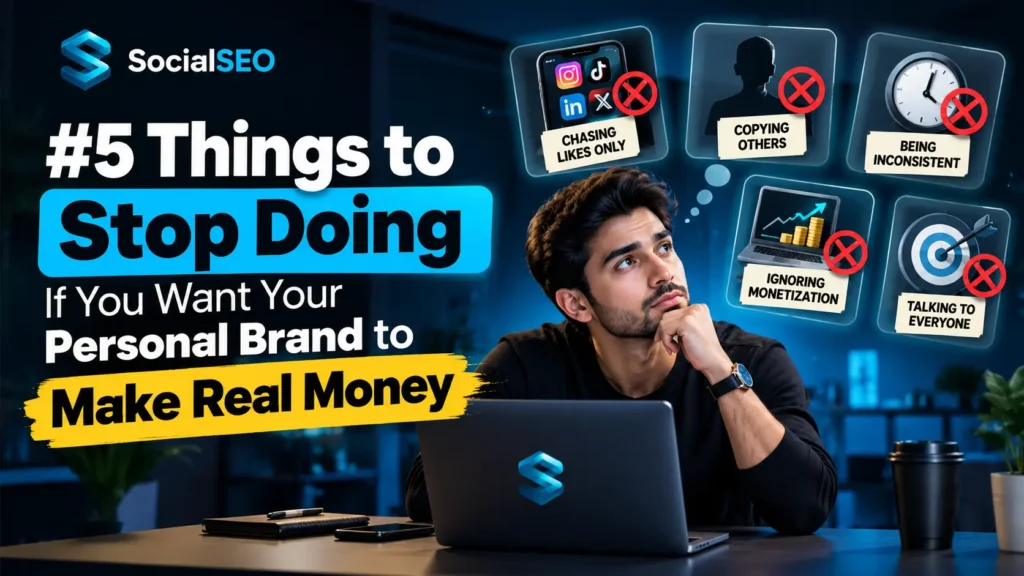
5 Things to Stop Doing If You Want Your Personal Brand to Make Real Money
Summary
You post. You show up. You still don’t see the money. If that sounds like you, you’re not alone, and it usually has little to do with effort.
So we have talked about these things, how they are keeping the personal branding from earning money, not having the good deals, chasing followers, posting to trends and wait for the right time. For each one you will get a fix and one number to track
You’ll also see the real math behind discounting, three ways to reach 20 lakh, India creator income data and a simple 10 person test. We also tell you where this advice doesn’t fit, so you can use it with open eyes.
Key takeaways
- A follower costs one tap. A client costs trust. Count your conversations, not your followers.
- Trend views come from people who like the trend. Make your content for the one person who can actually pay you.
- A full calendar is not a full pipeline. Post when you have something useful to say to your ideal client.
- A 20% discount can mean finding about 67% more clients just to earn what you earned before. Hold your price and change the package instead.
- You will never feel fully ready. Write a one page offer, send it to 10 people and see what comes back.
Introduction
You may have seen the reel. A creator says they made 20 lakh with only 2,000 followers, and they credit a list of things they stopped doing. Plenty of people watch it and think the same thing: my personal brand is not making money, so what am I missing?
In this guide we’ve pointed out the top 5 things that you should avoid or stop if you are doing that and also we have shared the fix for each mistake..
The short answer
The only way to earn from personal branding is to provide offer not just posting the attention building content by posting on trends, not approaching for good deals and waiting for the right opportunity or time, because to earn you need to sell the clear result to the clients.
Why your personal brand is not making money

A personal brand builds trust. Trust alone does not pay your bills. Money shows up when three things meet: a clear offer, a fair price and an easy way to buy.
Marketing writer Mark Schaefer describes a common pattern. He checked the website of a person who had worked hard on their brand and still earned nothing. The site talked about how great the person was, but it never said which problem they solved. You can read his full breakdown in five pitfalls of personal branding.
Try this ten second test on your own profile. Can a stranger tell who you help, what result you give and how to hire you? If the answer is no, more followers will not fix your income.
Stop 1: Chasing followers
A follower costs one tap. A client costs trust, time and money. That is why a big follower count can sit next to an empty bank account.
How many followers do you need to make money from a personal brand?
Fewer than you think. Test the reel’s claim with simple math. Ten clients paying Rs 2 lakh each makes 20 lakh. Ten people out of 2,000 followers is just 0.5%. This is an example, not a promise, but it shows why a small audience of the right people can be enough.
Small accounts also tend to have higher engagement. A 2026 benchmark roundup from Archive, which cites The Social Cat’s report, puts Instagram engagement at about 2.71% for creators with 1,000 to 10,000 followers. It puts mega accounts at 0.92%. Those figures come from brand campaigns, not service sales, so read them as a direction, not a guarantee.
The 1,000 True Fans idea, updated
Kevin Kelly argued years ago that 1,000 true fans paying $100 a year could support a creator. Li Jin at a16z pushed the idea further in 1,000 True Fans? Try 100. She said 100 true fans paying $1,000 a year can work too, if you give them real results. One Teachable creator in her piece earned $110,000 from just 76 students.
The lesson is simple. A few people who pay well beat a crowd that never pays.
What Indian data says
A BCG report, covered by BOOM, found that only 8 to 10% of India’s 2 to 2.5 million active creators earn meaningful income. Most earn under Rs 18,000 a month. A big audience is not a plan by itself.
- Stop: judging your brand by follower count
- Fix: list your 50 most engaged people, reply to every comment and DM, and mark the ones who match your ideal client
- Metric: replies, DMs and discovery calls per week
If you already have a large audience and still get no enquiries, read our guide on why founders with 100K followers still get no leads.
Stop 2: Posting to trends
Trending audio got the creator in the reel views and zero clients. That makes sense. A trend attracts people who like the trend. Your ideal client is busy looking for a fix to a problem.
Should businesses use trending audio?
You can, but do not expect clients from it. In a July 2026 Ask Me Anything, Instagram head Adam Mosseri said the platform does not punish popular audio, according to Kontentino’s write up. So the issue is not reach. The issue is who you reach.
Why your reels get views but no clients
Views measure attention. Clients come from a match between your content and a problem they pay to solve. Build every reel in three parts:
- Hook: name a problem your ideal client has this week.
- Body: show how you solve it, using your own method or a real client result.
- Filter: ask people to comment a keyword only if they fit. For example, “Comment AUDIT if you sell services above Rs 25,000.”
Use a trend now and then when it truly fits your message. Never build your plan on it.
- Stop: making content for strangers
- Fix: write each post for the one person who can pay you
- Metric: qualified DMs per post, not views
Stop 3: Being on camera to look busy
Posting on a schedule feels like work. You film, edit, post and repeat. But a full calendar is not the same as a full pipeline.
A 2016 Entrepreneur article told readers they were probably not posting enough. That advice made sense when attention was cheap and feeds were quieter. Today the better rule is the one in the reel: record when you have something to say.
The signal test
Before you hit record, finish this sentence: “After watching this, my ideal client will understand, decide or ask for ______.” If you cannot fill the blank, skip the post.
Build three content pillars
Pick three themes tied to your offer, so every post has a job:
- Mistakes your buyers keep making
- Results you have delivered
- Questions buyers ask on discovery calls
Showing up is not the problem. Showing up with no point is. For help with how your videos look and sound, see our guide on raw versus polished content.
- Stop: filming to fill a calendar
- Fix: run a minimum week of two posts that pass the signal test, plus five thoughtful comments on posts by your ideal clients
- Metric: conversations started per week
Stop 4: Discounting to win deals
Low prices often attract clients who are hard to satisfy. Many freelancers and consultants find that clients who negotiate the most over price also demand more changes and appreciate their work less. That is a pattern, not a law. The math below shows why discounting is risky even when the client is lovely.
Why discounting backfires
A discount tells the buyer your price was never firm. It pulls in people who compare you on cost alone. And it cuts your profit by far more than the discount looks.
What a discount really costs you
Say you charge Rs 50,000 for a package and it costs you Rs 25,000 to deliver. That is a 50% margin, so you earn Rs 25,000 per client. Offer 20% off and the price drops to Rs 40,000. Now you earn Rs 15,000. To match your old profit, you need about 67% more clients. Ten clients become about seventeen.
The lower your margin, the worse it gets:
- At a 50% margin, a 20% discount needs about 67% more clients to match your profit.
- At a 40% margin, it needs twice the clients.
- At a 30% margin, it needs three times the clients.
These numbers assume your cost per client stays the same. If you sell your own time, every extra client also costs you extra hours, so the real picture is tougher.
How do you stop clients asking for a discount?
- Ask about budget on the first call, before you send a proposal.
- Sell fixed packages with a clear scope, so there is nothing vague to trim.
- Show three tiers. The middle one looks fair next to the top one. This is called price anchoring.
- Give value, not a lower price. Offer a bonus review call instead of Rs 10,000 off.
- Use a script: “My price for this is Rs X. If the budget is tight, I can reduce the scope to Y.”
- Politely say no to clients who only care about getting the lowest price. Getting a no from the right client is better than saying yes to the wrong one.
What if it’s your first client? Instead of lowering your price, offer them a small trial project. Clearly explain what work you’ll do and when it will finish. Tell them your regular price, and ask them to share a review and let you use the project as an example of your work.
- Stop: cutting the price to close
- Fix: hold your price and change the package
- Metric: average revenue per client, profit margin and the share of proposals accepted at full price
Stop 5: Waiting until you feel ready
Ready is a feeling. Demand is a fact. You can wait years for the first, or test the second this week.
Why waiting feels safe
Waiting protects you from hearing no. It also stops you from learning anything. Many people polish a logo, a website and a course outline while nobody has been asked to buy.
How do I know my offer is ready to sell?
Use a minimum bar, not a mood. Your offer is ready enough when you can state:
- Who it is for
- The problem it solves
- The result and the timeline
- The price
- One proof point, even a free pilot or a small result of your own
The 10 person offer test
Hypefury suggests drafting an offer in a Google Doc and sending it to 10 people, which takes an afternoon instead of six months of audience building. You can read it in 3 reasons your personal brand isn’t making money. Here is how to run it:
- Write a one page offer using the fields above.
- Send it to 10 people who match your ideal client, using the script in the templates section.
- Read the replies. No replies means your message or positioning is unclear. Interest without a yes means price, trust or proof is the gap. A yes means deliver well, then ask for a testimonial.
One fair warning. Some solopreneur writers argue that launching early only tells you whether people want an offer, and ten people is a small sample. They have a point. Treat the test as a signal, not a verdict, and repeat it with ten new people.
- Stop: polishing before you test
- Fix: sell a minimum offer to ten warm people this week
- Metric: replies, calls booked and your first paying client
When this advice does not fit you
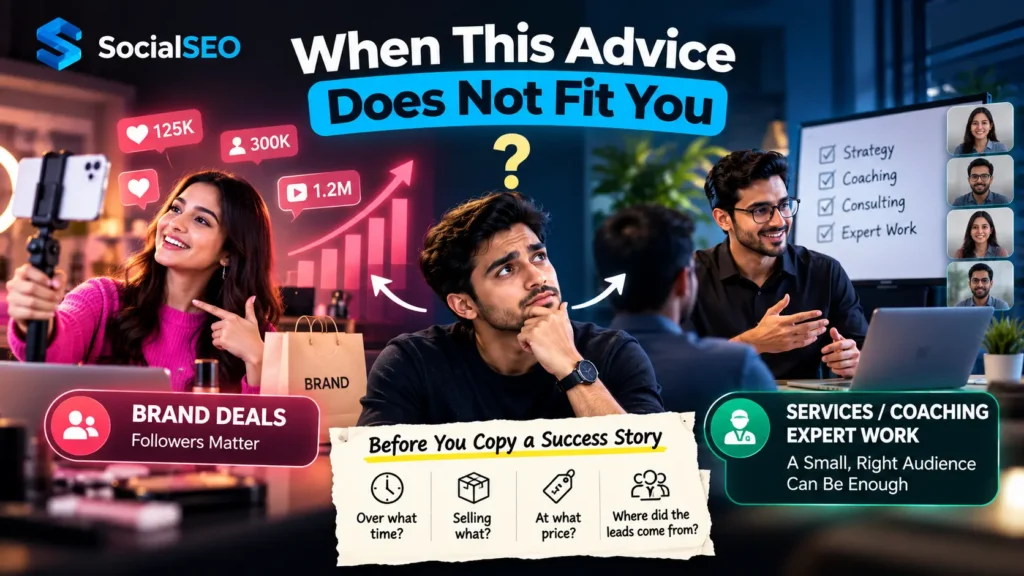
Match the rule to how you earn.
If your income comes from brand deals, followers still matter a lot. A Kalaari Capital report, covered by YourStory in 2023, said creators with 10,000 to 10 lakh followers earn roughly Rs 16,000 to Rs 2 lakh a month, while those above 10 lakh followers earn about Rs 2 to 52 lakh. If you sell a service, coaching or expert work, a small group of the right people can carry your income.
Also remember survivor bias. Stories like “20 lakh from 2,000 followers” get shared because they worked. Before you copy one, ask four questions: over what time, selling what, at what price, and where did the leads come from?
What 20 lakh can look like
Here are three illustrative paths to Rs 20 lakh. They are examples, not results.
- 4 clients at Rs 5 lakh each
- 10 clients at Rs 2 lakh each
- 40 clients at Rs 50,000 each
Now add a simple pipeline estimate. Say 1 in 5 discovery calls turns into a client. Four clients need about 20 calls. Forty clients need about 200 calls. Fewer, higher priced clients mean fewer sales calls and less delivery work. That is one more reason to stop discounting.
Templates you can copy
One page offer doc
- Who it is for
- The problem
- The result you deliver
- The timeline
- The price
- How to start
DM script for the 10 person test
“Hi [name], I am putting together a [result] package for [type of client]. It takes [timeline] and costs Rs [price]. Can I send you a one page summary? I would value your honest view.”
Price floor formula
(Your monthly costs + the income you want) ÷ the clients you can serve well each month = your minimum price per client.
Example: Rs 30,000 costs plus Rs 1,20,000 target income is Rs 1,50,000. Divide by 5 clients and your minimum price is Rs 30,000, before tax.
Ideal client worksheet
- Role and industry
- Budget range
- Their top three problems
- Where they spend time online
- What proof they need before they buy
Frequently asked questions
Why is my personal brand not making money?
Most often you built attention before an offer. Your audience may not know what you sell, who it is for or what it costs. Fix the offer, the price and the path to buy first. Then use content to send the right people there.
Can you make money with 2,000 followers?
Yes, if some of them can pay and you have a clear offer. Ten clients at Rs 2 lakh each is 20 lakh, which is 0.5% of 2,000 followers. Followers help only when they turn into conversations.
Should freelancers give discounts?
Rarely. A discount cuts profit far more than it looks, and it attracts buyers who compare on price. Offer a smaller scope, a bonus or a pilot with a testimonial instead. Keep your standard price firm.
How do I get my first client with no audience?
Write a one page offer and send it to ten people who match your ideal client. Use your network, past colleagues and referrals. Offer a pilot with a fixed scope and ask for a testimonial in return.
Is personal branding worth it in India?
It can be, but followers alone rarely pay. BCG’s report says only 8 to 10% of India’s 2 to 2.5 million active creators earn meaningful income. A clear offer sold to a defined buyer gives you more control than brand deals or ad rates.
How many clients do I need to make 20 lakh?
It depends on your price. Four clients at Rs 5 lakh, ten at Rs 2 lakh or forty at Rs 50,000 all reach 20 lakh. Fewer, higher priced clients mean fewer sales calls and less delivery work.
Final thoughts
Look at these five mistakes together. Chasing followers, following trends, making videos just to stay active, offering discounts, and waiting until you feel ready all have one thing in common. They make your business look busy, but they don’t actually help you grow your business.
Pick a single action this week. Write the one page offer, send it to ten people and read what comes back. You will learn more from that afternoon than from another month of posting.
If you want a team to handle the content side, see our founder personal branding service or get in touch. To see how long results usually take, read how long it takes to build a personal brand as a founder.
About the author
SocialSEO Team
We are the content and strategy team at SocialSEO, a social media and personal branding agency in Noida, Delhi NCR, founded by Suresh Malani. Day to day, we help Indian founders and brands turn their real voice into content that people trust.
We wrote this guide because we keep seeing the same story. People post every week, watch their numbers grow and still wonder why the enquiries never come. So we did the homework. We read how other guides cover this topic, opened every source we link to and checked the numbers on the page. We also marked the places where the evidence is thin. The 20 lakh examples are illustrative, and the post says so.
We would rather give you a straight answer than a big promise. If something here doesn’t match your experience, tell us. If you want a second pair of eyes on your own brand, reach out through our contact page and we’ll gladly take a look.
