Why Founders With 100K Followers Still Get No Leads (And How to Sell a Position Instead of Information)

Summary
We often see that the creators or founder who have more followers they lack in terms of lead generation because their content strategy is not well they sells information which is very good for the followers who wants good information but if anyone want to generate from you social media account with 100k followers or more than that you need to build trust and also do an audit understand your audience to know out of them which are your buyers. So, in this guide we’ve talked about how to audit your social media, how to shape your content based on your goals and also give three questions to find your angle and a 7 day reset to start fixing it.
Key takeaways
- Followers measure attention, and leads measure trust. You can have a mountain of the first and none of the second.
- Information is a commodity. Anyone can get the same tips in four seconds, so nobody DMs you to pay for them.
- A position is a point of view that a buyer wants to share. It names a side, so it repels some people on purpose.
- Many large audiences are mostly peers, fans, and sellers. A quick follower audit shows how many real buyers you have.
- Most followers are not ready to buy today. Position posts build memory, and proof posts help the few who are ready.
- Leads also leak after the follow. Check your audience, position, offer, path, and follow up speed, in that order.
Why you have followers but no leads
You post every day. Your reels look sharp. Your follower count keeps climbing. Then you open your DMs and find nothing from anyone who wants to pay you.
If that sounds familiar, you are not doing something wrong in the usual sense. You are doing the visible work well. You show up, you edit, you grow. The problem sits one layer deeper, in what the content actually says.
This pattern is common enough that founders describe it in the same words. Some say they have thousands of followers and never got a single inbound lead. Others say people like their posts and still never ask what they sell.
Here is the plain version of what is happening. Your audience is paying attention, but attention is cheap. A follow costs one tap. A DM that says “I want to work with you” costs trust, and trust comes from somewhere else.
Nat Eliason made a similar point years ago. His agency, Growth Machine, was earning over $100,000 a month while it had only a couple hundred Twitter followers. His takeaway was that followers and buyers are different groups, and the second group is the one that pays. You can read his short essay, Seek Buyers, Not Followers.
Information is free now
Think about what most founder content looks like. Five tips to get clients. Three mistakes to avoid. A simple framework for better sales calls. It is useful, and it is also everywhere.
When your content is information, your audience can use it without you. They save the post, try one idea, and move on. Nobody sends a DM to buy something they just got for free.
AI made this worse. Anyone can now ask a tool for ten tips on any topic and get a decent answer in seconds. If your posts could have been written by a search, they will be treated like a search result.
Buyers at the top of the market want something else. A 2025 survey by Edelman and LinkedIn covered nearly 2,000 B2B professionals. It found that 91% of hidden buyers want insights that reveal risks or opportunities they have not seen. It also found that 86% prefer views that challenge their assumptions. You can read the summary at Demand Gen Report and the source on the Edelman report page.
Hidden buyers are the people who shape a deal without ever talking to you, such as finance, operations, legal, and procurement. This survey is global and B2B, so treat it as a strong signal, not a promise about your market. Still, the message is clear. People reward a point of view, not a pile of tips.
One more thing. Many guides tell founders to educate 80% of the time and promote 20%. That advice is fine as far as it goes, but it never says what the 80% should argue. If the 80% is generic, you end up as one more voice sharing tips.
What is a position, and how is it different from information?
A position is a point of view that someone wants to be on the same side of.
Information tells people how to do something. A position tells them what you believe about the work, the market, or the people in it. Information is about the topic. A position is about you, your buyer, and what you stand against.
Here is a simple test with four questions:
- Who is it for? A position names one kind of buyer, not everyone.
- What do you believe? It states a clear claim, not a safe summary.
- What do you stand against? It names a common habit or belief you reject.
- Who does it repel? If it repels nobody, it is probably information.
That last question matters most. Tips offend no one, which is exactly why they build nothing. A position makes the right person nod and the wrong person scroll on. That is the point.
Three quick rewrites
These are made up examples to show the shift.
Headline. Before: “Founder at an accounting firm. Helping businesses grow.” After: “I help small CA firms win clients without cold calling.”
Post hook. Before: “5 tips to get more clients on LinkedIn.” After: “Stop posting tips. Your buyers can get tips free. Post what you refuse to do.”
Call to action. Before: “Follow for more.” After: “Comment ‘position’ and I will send you three questions to find your angle.”
Notice the pattern. The better versions pick a side and invite a conversation. They do not ask for a follow.
Who actually follows you? Run a follower audit
Before you change anything, find out who is in the room. A big number can hide a very small number of buyers.
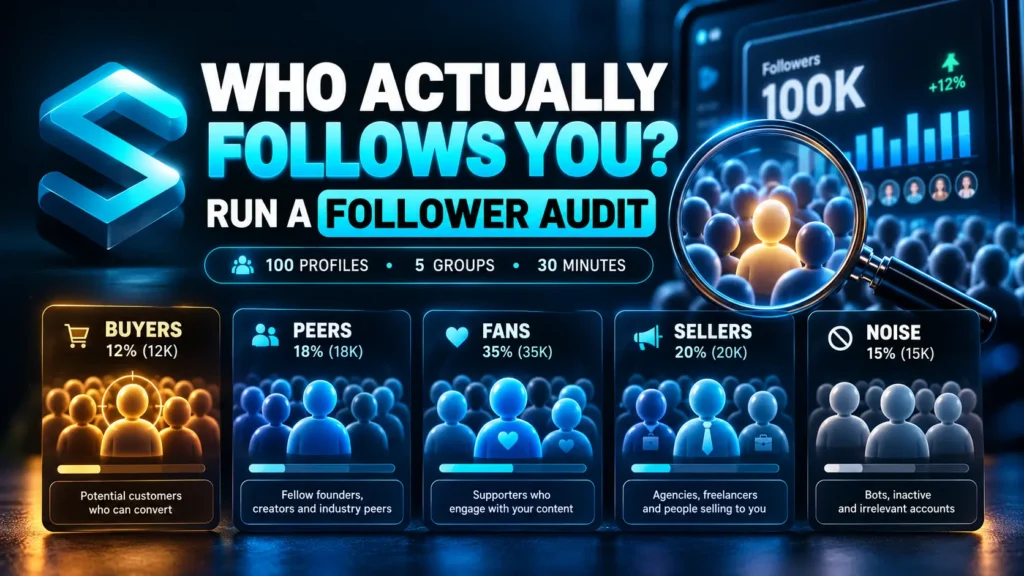
Here is a quick audit you can finish in about thirty minutes.
- Open your last three posts.
- Write down 100 profiles that liked or commented.
- Sort each profile into one of five groups.
The five groups:
- Buyers. People who could pay you or refer someone who would.
- Peers. Other founders, marketers, or creators in your own lane. They like your posts, but they sell what you sell.
- Fans. People who enjoy you and will never hire you.
- Sellers. Agencies, freelancers, and tool vendors who follow you to pitch you.
- Noise. Bots, giveaway accounts, and people from comment swap groups.
Now count how many fall into the Buyers group. That is your buyer share. I will not give you a magic percentage, because it changes by niche and price. Track your own number every month. If it is low or falling, your content is pulling in the wrong crowd.
Then add a second check. Count how many DMs you got from real buyers in the last 30 days. Compare that to your views. If views are high and buyer DMs are near zero, you have an audience problem, not a content volume problem.
Founders often miss a slow trap here. When you chase reach, your content gets broader. Broad content attracts a broader crowd. Over time your audience drifts further from the people who can pay you.
The peer trap
Peers are the easiest group to attract and the hardest to monetize. They comment fast, they share your posts, and they make your numbers look healthy. But they cannot buy what they already sell.
Engagement groups can add to this. Pods and comment swaps raise your counts, but they do not turn those people into buyers. LinkedIn’s own community policies also tell members not to agree in advance to like or re-share each other’s content. The page LinkedIn engagement pods: what LinkedIn’s own rules say quotes that policy and explains the risks. Nobody outside LinkedIn knows how strictly it enforces this, so weigh the risk yourself. The bigger cost is simple: you end up with applause from people who will never pay you.
Why most of your followers will not buy today
There is a useful idea from B2B marketing called the 95/5 rule. It says that only about 5% of buyers are ready to buy at any moment. The other 95% will buy someday, but not now.
The rule comes from Professor John Dawes at the Ehrenberg-Bass Institute, and LinkedIn’s B2B Institute published it in 2021. Dawes himself says the numbers are a rough guide, not an exact law. A good explainer is The 95/5 Rule Explained.
This changes how you think about your followers. Most of them are not in market. They are not looking to hire you this month. So the job of your content is not to push them to buy. The job is to be the name they remember when they finally need someone.
That is where a position helps and information does not. A clear position builds what marketers call mental availability, which means you come to mind at the right moment. Tips do not do that, because tips sound like everyone else’s tips.
Here is how each type of post works across the two groups:
- Position posts build memory with the 95% who are not ready yet.
- Proof posts, such as case studies and client stories, help the 5% who are comparing options.
- Information posts do neither well. They teach a skill the reader can use without you, and they do not make you memorable.
The Edelman and LinkedIn survey points the same way. It found that more than 40% of B2B deals stall because people inside the buying group disagree. It also found that 79% of buyers are more likely to champion a vendor in the final stage if that vendor has shared quality thinking consistently. Your position gives those quiet influencers something to remember and defend.
The five leaks between a follower and a lead
Even with a good position, leads can leak at several points. Check them in order, because most founders fix the wrong one first.
1. The wrong crowd. If your audience is mostly peers and fans, nothing else will work. Fix this first with the audit above.
2. No position. If a stranger cannot say in one sentence who you help and what you believe, they have no reason to choose you. Fix the message before you fix the format.
3. An unclear offer. Some people want to hire you and cannot tell what you sell, who it is for, or what it costs. Say it plainly in your bio and your pinned post.
4. A hard path. If someone has to guess how to reach you, they will not. Pick one next step. It might be a DM keyword, a booking link, or a WhatsApp number. Then repeat it in your content.
5. Slow follow up. A lead that waits days for a reply often goes cold. Decide who replies, how fast, and what they say. Leads rarely fail because they were bad. They fail because nobody answered while interest was high.
A quick note on calls to action. A free checklist can bring in the wrong people if the position is weak. Lead with the position first. Then invite a conversation about a problem, such as “Comment ‘position’ and I will send you the three questions.” That kind of call to action filters for people who care about the idea.
How to find your position: three questions
If you want to find your own angle, start with these three questions. Write your answers down, and be honest.
- Who is the one buyer you want more of, and what do they believe that most of your industry gets wrong?
- What do you refuse to do or say, even if it would win you more followers?
- What would a stranger have to agree with before they trusted you enough to message you?
Then turn your answers into a simple position statement:
For [type of buyer] who [has this problem], I believe [your claim]. So I [what you offer]. Unlike [the common approach].
Here is a made up example. “For small clinic owners who feel stuck on discounts, I believe patients choose clinics they trust, not clinics that are cheap. So I help clinics build a doctor led brand. Unlike agencies that just post offers.”
Read your statement out loud. If it sounds like something any competitor could say, sharpen it. If it makes you slightly nervous, you are probably close.
What to post once you have a position
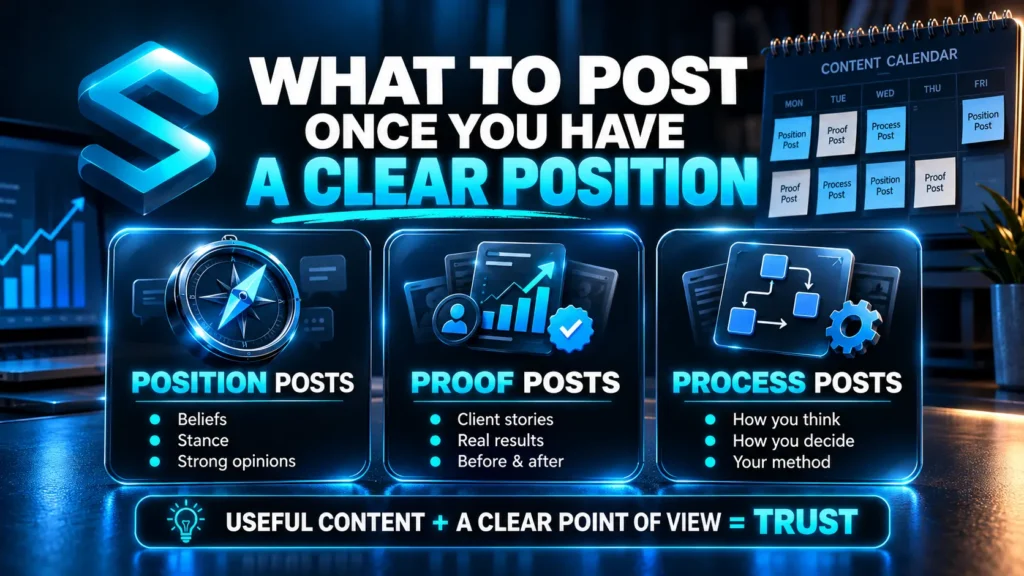
You do not need to abandon useful content. You need to make it carry a point of view. A simple mix works well for most founders:
- Position posts. Share a belief, a stance, or a strong opinion about your market. Say what you stand against.
- Proof posts. Share a client story, a result, or a before and after. Use real, approved results only.
- Process posts. Show how you think and decide. This is where useful information fits, because it now supports your stance instead of replacing it.
Now with consistency and trusted content use the two or three pillar that are stated above create a calendar and stay consistent to to it because consistency build trust, and also use generic content so that it helps to build the audience not buyers.
For founders who sell through Instagram lead generation or LinkedIn lead generation, the same rule applies on both. If you are still deciding between platforms, our guide on Instagram vs LinkedIn personal branding for Indian founders covers that choice. And if you worry about polish, our piece on raw content vs polished content explains how to think about it. Here we only need one point: your stance matters more than your production style.
The product launch trap
Here is a pattern you may have seen. A creator with a huge following launches a product. The launch is loud, and then almost nobody buys.
The cause is the same. The audience followed the personality, not the position. People enjoyed watching the creator. They did not necessarily agree with a point of view that the product stands for, so they had no reason to pay.
If you plan to launch something, ask one question first. Would my audience buy this because they believe what I believe, or only because they like watching me? The first group buys. The second group claps.
A position can belong to your company
There is a quieter reason to sell a position. A personality leaves with the person. A position can stay with the business.
Joe Pulizzi built Content Marketing Institute around his own voice, then spent years moving the brand away from himself. He sold the company in 2016 for $14.75 million. He said the changes that removed his personal brand from the center helped make the sale possible. The full story is on They Got Acquired.
If you build a business on one clear idea, other people can carry it. That makes your company easier to grow, hand over, or sell. We cover the wider risks of leaning too hard on one face in Why Every Indian Founder Needs a Personal Brand, so we will not repeat them here.
When a big audience does pay
To be fair, a large following is not useless. Some business models really do earn from audience size.
- Brand deals and sponsorships pay for reach.
- Affiliate income grows with traffic.
- Ad revenue and mass market courses reward big numbers.
If your income comes from attention itself, then follower count matters. The problem we are solving is different. It applies to founders who sell a service, a high ticket product, or expert work. For those founders, a smaller group that trusts you beats a larger group that only watches.
For Indian founders: the DM to WhatsApp handoff
Many buyers who find you on Instagram or LinkedIn will want to move the conversation to WhatsApp before they pay. Plan for that move before it happens.
Decide who replies, how fast, and what you say first. Share your price range in rupees early, so you do not waste time with people who cannot afford you. If you serve local clients in Noida or across Delhi NCR, say that in your bio so nearby buyers can find you.
A “comment to get” prompt can start these chats. If you want to see how that works step by step, read our guide on Instagram comment to DM automation. Remember that a keyword only starts a chat. Your position decides whether the chat ends in a sale.
Your 7 day position reset
You do not need a big plan. Try this one week reset.
- Day 1. Run the follower audit on 100 profiles.
- Day 2. List ten real buyers you want more of and note what they have in common.
- Day 3. Write your three answers and your position statement.
- Day 4. Rewrite your headline and bio so they name your buyer and your stance.
- Day 5. Draft three position posts. Each one should name something you stand against.
- Day 6. Pick one next step for interested people and add it to your bio and posts.
- Day 7. Set a follow up rule, such as replying to every qualified DM within a few hours.
Then repeat the audit after a month and compare your buyer share. If you want to know how long a personal brand usually takes to show results, our guide on how long it takes to build a personal brand as a founder explains the real timeline.
Frequently asked questions
Why do I have followers but no customers?
Your followers may be peers, fans, or sellers instead of buyers. Or your content may teach tips that anyone can find free, so nobody has a reason to hire you. A clear position and a better audience fix both problems.
Why is nobody DMing me on Instagram?
People DM when they trust you and know what to ask for. If your posts are generic and your next step is unclear, they have no reason to message you. Add a clear stance and one simple call to action.
Why does my content get views but no leads?
Views measure attention, not buying intent. High views from the wrong crowd can sit next to zero leads. Check your buyer share and make sure your content speaks to one kind of buyer.
Does follower count matter for sales?
It matters when you earn from attention, like sponsorships or ads. For service and expert businesses, the quality of your audience matters more than its size.
Is a big following worth it for a founder?
It can be, but only if your followers include real buyers. A smaller group of the right people is more valuable than a large group of fans.
How many followers do you need to get clients?
There is no fixed number. Relevance beats size. A founder with a few thousand well matched followers can get more leads than one with a hundred thousand mixed ones.
What is the difference between audience and customers?
An audience watches you. Customers pay you. Moving from one to the other needs trust, a clear offer, and an easy next step.
What is the difference between attention and trust?
Attention is a quick tap on a post. Trust is the belief that you can solve a problem. Followers measure attention, and leads measure trust.
How do I know if my followers are real buyers?
Run a follower audit. Sort 100 recent engagers into buyers, peers, fans, sellers, and noise. Then track how many buyer DMs you get each month.
What should founders post to get leads?
Post a mix of position posts, proof posts, and process posts. Each should speak to one buyer and make your stance clear.
How long does it take to turn followers into leads?
It depends on your starting point and consistency. A clear position and a better audience usually matter more than posting more often.
Should founders sell information or a point of view?
A point of view. Information is easy to find for free, so it rarely drives a purchase. A clear position gives buyers a reason to pick you.
Final thoughts
If you remember one thing, remember this. You are not selling information. You are selling a position.
Followers tell you that people noticed you. Leads tell you that people trust you. Those are different things, and most founders only measure the first.
Start with the audit. Find out who is really in your audience. Then choose a side, say it clearly, and make the next step easy.
If you want help finding your real angle, you can book a free strategy call or learn how our founder personal branding service works. And if you saw our reel on this topic, comment “position” there to get the three questions.
About the author
We are the content and strategy team at SocialSEO, a social media marketing and personal branding agency in Noida, Delhi NCR, founded by Suresh Malani. We help Indian founders turn their real voice into reels, carousels, and posts that earn trust, and we handle the strategy, scripting, production, and posting for them. We wrote this guide after seeing founders with big follower counts and empty DMs. We backed it with published research from Edelman and LinkedIn and the 95/5 rule from the Ehrenberg-Bass Institute. Want help finding your own angle.