The Creator Agency Model: How Talent Management Businesses Make Money From Fame
Summary
Going viral gives a creator attention, not a steady income. Creator agencies fill that gap. They find creators, sign them and manage their careers, usually for a 10 to 30% commission.
The best agencies go beyond commission. They add retainers, products, equity and original IP, so creators own assets that keep paying. Funnels like talent shows can feed an agency’s roster, but one show is a single point of failure.
Before you sign with any agency, check the commission base, exclusivity and tail clause. Small creators can often pitch brands on their own. Busy creators may gain from a manager who proves results in their niche.
Agencies work best when they treat creators as long term partners and help them build something they own.
Key Takeaways
- Creator agencies earn mainly through commission, and the best ones add retainers, products, equity and ventures.
- Stacked commissions can take 25 to 40% of a deal, so read how percentages are calculated.
- Talent funnels turn shows and contests into rosters, but they carry a single point of failure risk.
- Agencies carry cash flow pressure, which explains why some pay creators late.
- Check the commission base, exclusivity and tail before you sign anything.
- You do not need fame to run an agency, but you do need fair terms and real service.
Introduction
Nowadays anyone can get viral and get millions of views easily but also it doesn’t mean the million of views pays you today, it will take some products, deals and ownership to create a steady income, and for that a creator agency comes into place.
In February 2026, the talent firm Night raised $70 million to build and buy businesses in media, music, gaming and live events. A talent manager raised that much money because the real business is no longer just booking sponsorships. It is owning a share of what fame creates.
This guide explains the creator agency model in plain words. You will see how agencies earn money, what the math looks like for both sides, how talent funnels work, where contracts go wrong, and what the India market looks like. If you are a creator, you will learn what to ask before you sign. If you want to start an agency, you will learn what most guides leave out.
The Quick Answer
There are too many ways agencies earn from their creators, one of the most common way is they take commissions from creators earnings like 10% to 30%, some like sharing the revenues on subscriptions, products deals, or creators business and ventures. But strongest agencies move creators from one off brand deals toward assets that keep paying, such as products, IP and equity.
What Is the Creator Agency Model?
The creator agency model is a business where a company finds creators, signs them, manages their careers and earns a share of their income. The agency brings deals, contracts, strategy and support. The creator brings the audience.
The words get mixed up a lot, so here is the simple version.
A talent manager guides a creator day to day. They advise on content, brand choices and career moves, and they often handle only a few creators at a time. A talent agent finds and negotiates specific deals. An agency is a company that employs several managers and agents and holds a bigger roster. An influencer marketing agency works for brands, not creators. A brand hires it to run a campaign with many creators. A multi channel network, or MCN, pools channels and takes a cut of their ad revenue, which is how companies like Maker Studios and Fullscreen grew in the early 2010s.
That last difference matters. When you read “agency takes 20%,” ask whose side the agency sits on. A creator management agency works for the creator. An influencer marketing agency works for the brand. Mixing them up leads to bad decisions.
Who Is a Managed Creator?
A managed creator is a digital creator, often a rising creator, who hands the business side of the work to a team. They keep making content, and the team handles negotiations, contracts, paperwork and planning. This suits creators who feel like solopreneurs buried in admin. They would rather outsource deal talk and focus on videos, posts and streams.
It does not suit everyone. Smaller creators with few inbound offers often do better pitching brands on their own. We cover that choice below.
Why Fame Needs Infrastructure
When Fame Outpaces Infrastructure
Nowadays if you had a good video and you posted on the page and peoples like that, so from that only creators are gaining 500k followers a month, and then brands start following them, and at that time they have not any support like an agency an accountant lawyer, and not any plan for the next 6 months
Platforms make this worse. Algorithms change without notice. A channel can lose reach overnight or lose its income through demonetization. Burnout hits when a creator feels forced to post every day to stay visible. Many creators end up as accidental entrepreneurs, running a real business with no business training.
This gap is the agency’s opportunity. The faster fame arrives, the more help creators need with contracts, taxes, cash flow and career longevity.
How Agencies Capture Value
Researchers who study person brands describe a value network with three players: audiences, brands and platforms. The creator creates value by attracting an audience. Brands, platforms and agencies then compete to capture part of it. An agency captures value by bundling resources around the person brand, such as deal access, legal help, production, merchandise and funding.
That framing explains why agencies go beyond commission. Commission captures a slice of one deal. Equity, IP and owned businesses capture a slice of the whole value network.
How Creator Agencies Make Money: The Seven Layer Revenue Stack
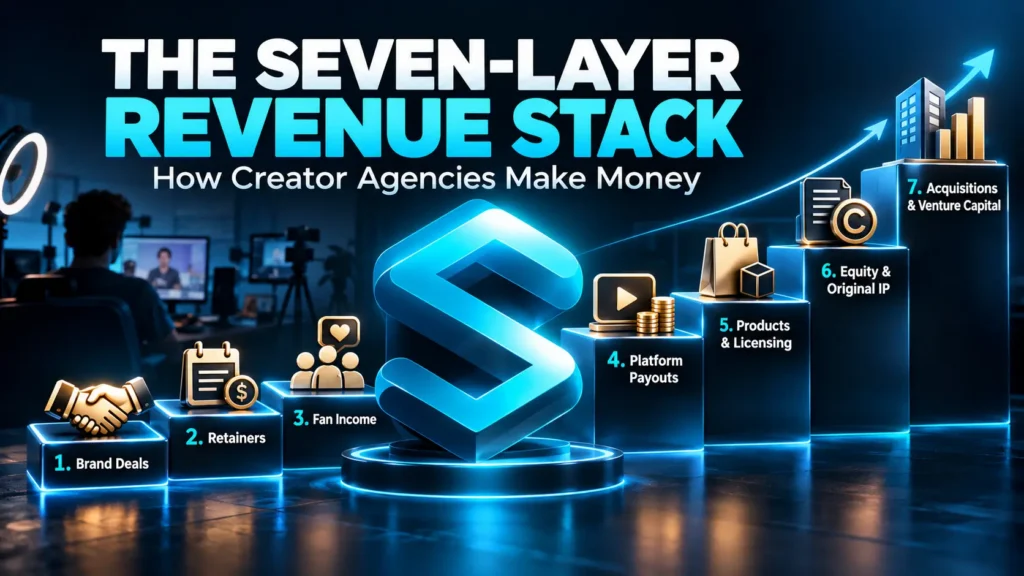
Think of agency income as a stack. The bottom layer is the oldest and most common. Each layer up asks for more skill and capital, and it can pay more.
Layer 1: Commission on Brand Deals
This is the base. A manager usually takes 15 to 20% of a brand deal. An agent or agency usually takes 10 to 20%. The cut comes out of the creator’s fee, not on top of the brand’s price.
If a creator has both a manager and an agency, the cuts can stack. Take a $10,000 deal. The manager takes 20%, which is $2,000. The agency takes 10% of the original amount, which is $1,000. The creator keeps $7,000, so 30% of the deal never arrives. Whether both cuts come from the same starting figure or one comes after the other is a contract detail, and it deserves a written answer before you sign.
Most digital creator deals have no legal commission cap. California’s Talent Agency Act sets limits for entertainment agents, but it does not govern every creator deal worldwide. The rate is whatever you agree to.
Layer 2: Retainers and Hybrid Models
Some managers charge a monthly retainer, so they earn even when no deal closes that month. One US manager reports seeing retainers from $800 to over $3,000 a month. Others mix both ways, for example a three month retainer followed by a lower commission, such as 10%, on later deals.
Retainers give the agency steady income and ask the creator to pay before results show up. Creators should ask what the retainer buys in clear terms.
Layer 3: Revenue Share on Subscriptions and Fan Income
Some agencies run or support fan subscription accounts. They help with account growth and auditing, content planning and fan messaging. Trained chatters may reply to fans through direct messages around the clock, and the team may work on upselling and winning back expired subscribers. In return, the agency takes a share of monthly subscriptions, private content sales and tips under a revenue sharing agreement.
Handle this layer with extra care. Platform community guidelines apply, creators need clear consent about who writes in their voice, and the contract should spell out the split and who owns the account. A creator should keep full control of logins and payouts.
Layer 4: Platform Payout Models
Some agencies earn from the platform, not from the creator. Talenture, a TikTok LIVE agency, says its creators keep 100% of their earnings, and the agency earns through a direct arrangement with TikTok and its own bonus structure. It says it manages over 3,000 creators. Treat this as the agency’s own account of its model and read any contract closely, but the idea matters: not every agency lives off creator commission.
Layer 5: Products, Licensing and D2C
Agencies help creators launch merchandise, digital products, courses, templates, paid communities and D2C brands. They also negotiate licensing deals and affiliate programs. This layer moves income away from one time sponsorships toward predictable monthly income.
Underscore Talent shows how far this can go. It helped the children’s channel Genevieve’s Playhouse expand to other streaming platforms and turn its characters into toys sold at Walmart and Target. The channel had earlier relied on other companies’ toys in its videos, so owning original characters changed its position.
Layer 6: Equity and Original IP
Equity means a creator takes a share of a company instead of, or beside, a fee. Friends In Reality, a New York management company, makes the case in simple terms: a creator could take a $100,000 brand deal or $100,000 worth of equity, and equity can pay far more if the company succeeds. Ponte Firm adds a useful warning: equity makes sense when the creator truly believes in the brand, not just because equity is on offer.
Viral Nation Talent pitches commerce, affiliate income, licensing, appearances and original IP developed for streaming platforms, with equity where it fits.
Layer 7: Roll Ups, Acquisitions and Venture Money
At the top, agencies behave like media companies. Night runs Night Capital, a $100 million venture fund it launched in 2022 with The Chernin Group, and it has bought a podcast network and a marketing firm. Creator economy deals grew 17.4% year over year to 81 in 2025. Publicis bought the influencer platform Captiv8 for $175 million. One investor, Nick, who now leads TBN Talent, describes talent management as fragmented and under run, which explains why investors want to roll up small firms. TBN itself charges commission only, and it expects the market to move toward equity style and revenue share deals.
The Funnel Model: When the Show Is the Top of the Funnel
Some agencies do not wait for talent to arrive. They build the place where talent gets discovered.
Picture a traditional sales funnel. Many people enter at the top, some move down, and a few become customers. A creator discovery funnel works the same way. A show, contest, collab house or content series draws a wide audience. A few performers break out. The company behind it then signs the best ones, manages them and earns from their growth. The show attracts the audience, and the roster produces the revenue.
Indian entertainment has real examples of the pieces. Only Much Louder produced Comicstaan, a talent hunt that Prime Video promoted as the search for India’s next big comedian. The same company has also managed comedians, according to older reporting. India’s Got Latent became a major discovery format for unknown performers, and Indian Television described it as a fast funnel that moves unknowns toward multi platform stardom. Its second season premiered on 20 June 2026, streaming on Netflix and YouTube together. These are separate facts about shows and companies. We found no public source that proves any one host runs an agency or takes a commission from contestants, so do not assume it.
Outside India, Reign Maker Group follows a similar signing logic. Its CEO said he built at the bottom so he would capture the talent that rises to the top. The group also runs the Creator Rep Institute, a three month program that trains new managers.
Why You Do Not Need to Be Famous to Run It
The manager’s job is sourcing, signing, contracts and systems. It does not need a personal audience. Plenty of agency founders stay behind the scenes and build roster, process and trust. That opens the door for people with sales, operations and relationship skills.
The Risks Nobody Posts About
A show is one point of failure. India’s Got Latent launched in June 2024 and shut down in February 2025 after backlash over one episode. A funnel that depends on one format can break fast, and controversy can touch the talent, the host and the whole pipeline.
Early signing also carries ethical weight. A new creator with no leverage can accept bad terms without knowing it. A commission on everything a creator earns after signing is the broadest version of a commission clause, and it can outlast the agency’s real contribution. A fair funnel gives creators a clear scope, a fair term and a real way out.
How Much Can You Earn With a Management Agency?
No honest guide can promise a number. Agencies do not create an audience out of thin air, and results depend on the creator’s niche, consistency and market. What you can do is run the math before you sign. All examples here are hypothetical.
The Break Even Test
Say a creator earns ₹50,000 a month from deals on their own. An agency takes 20%. For the creator to come out ahead, the agency must lift monthly deal income above ₹62,500. Anything below that, and the creator pays commission for no gain. Ask the agency for proof that it has done this for similar creators.
Moving from $1,000 a month to $10,000 a month rarely comes from commission alone. It usually needs a stronger niche, better pricing, more income streams and a steady posting rhythm. A good agency helps with those pieces and shows the plan in numbers.
Can’t I Just Do It Myself?
If you have follower under or equal to 100k so then you country to do deals alone, can talk with the brand, because only you need agency when you are gaining too much brand deals or have to negotiate with them or to get better deals from them or from other brands.
If you already have strong direct relationships with brands, negotiate a carve out before signing. List those brands in the contract so they stay commission free.
The Agency’s Side: Unit Economics and Cash Flow
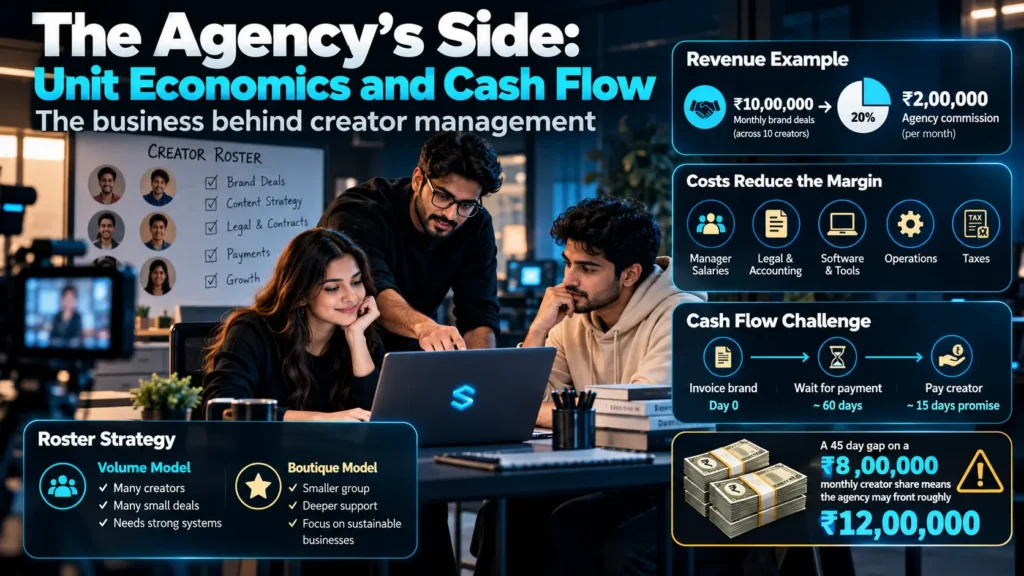
Most guides explain what creators lose. Few explain what agencies must carry. Here is a simple picture of the business side.
An agency with 10 creators earns commission on each deal. Say the creators bring in ₹10,00,000 of brand deals a month and the agency takes 20%. That is ₹2,00,000 in monthly commission. Now take out a manager’s salary, legal and accounting help, software and taxes. Margins look thinner than the headline rate suggests, and it takes a decent roster size to cover the fixed costs.
Cash flow adds pressure. The agency invoices the brand, waits for payment and then pays the creator. Station Entertainment, a talent management firm, estimates that about half of all payments to managers arrive late. If an agency promises creators payment in 15 days and the brand pays in 60, the agency covers the gap. On a ₹8,00,000 monthly creator share, a 45 day gap means the agency fronts roughly ₹12,00,000 at any time. Agencies that cannot carry that either pay creators late or run into trouble.
Roster strategy matters too. Underscore’s co founder describes a split in the market. Some agencies chase volume, signing many creators and closing many small deals. Others manage a smaller group closely and focus on building sustainable businesses, which he sees as less crowded. Both can work. Volume needs strong systems, and a boutique model needs deeper skill per creator.
Five Agency Models Compared
| Model | How the agency earns | Main risk for the creator | Main risk for the agency |
| Pure commission | Percentage of deals | Agency may chase quick deals | No income in slow months |
| Retainer or hybrid | Monthly fee plus lower commission | Paying before results appear | Hard to justify fee to small creators |
| Platform payout | Bonuses and platform arrangements | Dependence on one platform’s rules | Platform changes can cut income |
| Subscription revenue share | Share of fan income | Loss of control over account and voice | Reputation and guideline risk |
| Equity and IP | Ownership stake and venture upside | Conflict of interest, long lockups | Capital needs and slow payoff |
Use this table to match a model to your goals. Creators who want control and low risk often prefer pure commission with a short contract. Creators who want to build something to own should look at equity and IP, and ask hard questions about who controls decisions.
Is a Creator Management Agency Legit? How to Check
Plenty of good agencies exist, and plenty of poor ones do too. Use this checklist on any agency you consider.
Red flags
- No written contract
- Commission on everything you earn, with no exceptions, including deals you built before signing
- A rate above 20% with no explanation of the extra services
- Upfront startup fees or application costs
- A contract marked non negotiable
- Broad exclusivity that blocks all your income, not just management work
- No clear way to end the agreement
Understand the Commission Base and the Tail
Two terms decide how much a contract costs you. The commission base is the money the percentage applies to. Check whether it covers only deals the agency found, or all income including AdSense, affiliate revenue and merchandise. The tail, also called a sunset clause, gives the agency commission on deals after you leave. A fair tail covers only deals signed or substantially negotiated during the contract, steps down over time and ends after a set period, commonly six to eighteen months.
Questions to Ask Any Agency
- What do you take commission on?
- How soon do you pay creators after the brand pays you?
- How long do creators usually stay with you?
- What do you do beyond brand deals?
- Who owns my channel access, logins and content?
- Can I see what happens if we part ways?
Is Joining a Management Agency Right for You?
Ask yourself three questions. Do you get more offers than you can handle? Does negotiation take time away from creating? Can the agency show results for creators like you? If you answer yes to all three, representation may help. If not, build your own rate card and keep pitching.
The Creator Economy Behind the Model: The India View
Market size estimates for the global creator economy range widely, from about $234 billion to over $320 billion for 2026, depending on the source and method. Treat any single figure with caution, and look at the trend instead: more creators, more brand money and more business support around them.
Creators and startups make money in a handful of ways. These include subscriptions and memberships, advertising and sponsorships, creator owned products and D2C commerce, community platforms with premium memberships, SaaS tools and funding. Platforms like Patreon and Substack help with recurring income, while YouTube AdSense pays by CPM, which varies widely by niche.
What Indian Creators Face
In India, agency commissions reportedly range from 10% to 30%, and some creators mention rates as high as 40%. Storyboard18 reported complaints about delayed payments, unclear contracts and new agencies with little experience. Some established creators with direct brand access now leave agencies or negotiate lower rates.
Many Indian agencies mix several income streams. Finnet Media, for example, combines brand retainers, long term creator relationships and content production. Creators work across YouTube, Instagram Reels and local platforms like Moj, so an agency that understands each platform’s rules adds real value.
The legal and money maze deserves attention too. One India focused guide says agencies charge GST at 18% on commission and that commission businesses cannot use the presumptive tax scheme. Rules change, so confirm both points with a chartered accountant before building your pricing or contracts around them.
When the Model Fails
Every model has weak points, and a trustworthy guide names them.
Conflict of interest. An agency that holds equity or runs its own ventures can steer creators toward deals that help the agency first. Ask who decides, and ask how conflicts get handled.
Creator churn. Creators leave. MrBeast ended his exclusive relationship with Night in 2024, and Night still grew. Agencies that depend on one big name carry real risk.
The independence trend. Some creators now represent themselves again after bad experiences with fees and late payments.
Market saturation. Many creators chase the same niches. Standing out takes a clear USP, a strong personal brand and a loyal core fanbase. Brand consultants and good managers help here, but nobody can fake it.
The One Platform Trap
A creator who earns from one platform can lose income overnight. Algorithm changes cut reach. Demonetization removes revenue. Burnout makes it hard to stay consistent. Agencies reduce this risk by helping creators spread across platforms, grow organic traffic and build owned audiences like mailing lists and newsletters. A good plan uses multi channel marketing so that no single platform controls the business.
Where the Creator Agency Model Is Heading
Three shifts stand out.
First, agencies are becoming multi platform operators. They produce content, sell products, invest in businesses and build IP, not just book sponsorships.
Second, deals are moving toward equity and revenue share. When marketing budgets tighten, brands and creators prefer structures where both sides win only if results show up.
Third, owned audiences matter more. Creators who collect email lists, run paid communities and sell their own products depend less on any platform. This is how a creator middle class forms, with steady income that does not rely on hits.
The question has changed from “who will hire this talent” to “what can this talent own.” The agencies that answer it honestly, with fair contracts and real support for data driven decisions and content consistency, will earn trust. Success in this business means a creator who still has a career, an income and an audience a decade from now, not a creator who went viral once. In the end, the strongest brands belong to a tribe, not just a fanbase.
Frequently Asked Questions
How do creator agencies make money?
They earn commission on brand deals and other creator income. Many also charge retainers, take revenue shares on subscriptions, build products and licensing deals, hold equity in creator businesses or run their own ventures.
How much commission do management agencies take?
Managers typically take 15 to 20% and agents or agencies 10 to 20%. In India, reported rates range from 10% to 30%, with some going higher. Always ask what the percentage covers.
How much can you earn with a management agency?
It depends on your niche, audience and the agency’s skill. Use a break even test: divide your current income by one minus the commission rate. If the agency cannot lift your income past that number, the deal does not help you.
Can’t I just do it myself?
Yes, many smaller creators do. Pitching directly, building a media kit and keeping every deal often beats paying commission until deal volume and admin work grow.
Is joining a management agency right for you?
It fits creators who get more offers than they can manage, who want to spend time creating, and who find an agency with proof of results in their niche.
Can you start a talent agency without being famous?
Yes. The work depends on finding talent, signing fair contracts and running systems. Personal fame is not required, but trust, sales skill and real support for creators are.
How do talent agencies find and sign creators?
They scout on social platforms, run shows and contests, use referrals, and sometimes train new managers to build rosters. The best agencies explain terms clearly before asking anyone to sign.
What is a tail clause?
A tail, or sunset clause, gives an agency commission on certain deals after the contract ends. A fair one covers only deals the agency signed or substantially negotiated, steps down over time and ends after a defined period.
Is a creator management agency legit, and how do I check?
Look for a written contract, a clear commission base, no upfront fees, a fair tail, clear payout timing and a way to leave. Ask for references from current creators.
What is the difference between a creator agency and an influencer marketing agency?
A creator agency works for the creator and takes a share of their income. An influencer marketing agency works for brands and runs campaigns with many creators.
How do creator economy startups make money?
Through subscriptions, memberships, advertising, sponsorships, creator owned products, SaaS tools, community platforms and funding.
Conclusion
The creator agency model is simple at its core. A company finds creators, signs them and takes a share of what they earn. Everything else is about how far that idea stretches. Some agencies stop at a 15 to 20% commission on brand deals. Others add retainers, products, equity, original IP and ventures they own. A few even build the shows and contests that discover talent in the first place.
Three things are worth remembering before you act on any of this.
First, the percentage is only half of a contract. Read the commission base, the exclusivity scope and the tail clause, because those terms decide what a deal really costs you.
Second, run the break even math. If an agency cannot lift your income past the point where its commission pays for itself, you gain nothing from signing.
Third, remember that agencies carry real pressure too. Late brand payments, salaries and thin margins shape how they treat creators, so ask how and when you get paid.
If you are a creator, use the checklist in this guide before your next call with a manager. If you want to start an agency, you do not need fame. You need sharp sourcing, fair contracts and a system that creators can trust.
The creators with the most leverage are the ones who own an audience, a product or a brand of their own. If you want to build that kind of personal brand, you can see how SocialSEO’s founder personal branding service works, or book a free strategy call to talk through your own plan.
About the Author
Option A, written for Suresh Malani
Suresh Malani is the founder and strategist behind SocialSEO, a Noida based growth studio that builds guarantee backed personal branding and content distribution systems for Indian founders and brands. He works directly on client strategy and writes about personal branding, social growth and how founders and creators turn attention into business. Suresh built SocialSEO around one belief: attention is a distribution problem, not a creativity problem.
