
Why Agencies Should Stick With Proven AI Tools Instead of Chasing Every New Model
Summary
New AI models launch almost every week, and the pressure to switch never seems to stop. This guide explains why agencies get better results from proven AI tools than from chasing every new release. You will see what a model switch really costs in prompt rework, quiet quality drops and lost focus. You will also learn why clients care about results and not model names, and how to protect your workflow when a vendor retires a model. Along the way, you get a simple three test rule, a 10 task evaluation you can run in a week, and clear answers to the questions agency owners ask most.
Key takeaways
- Clients pay for rankings, leads and steady delivery. They do not pay for the newest model.
- Switching costs far more than a subscription. Expect prompt rework, retesting, team retraining and possible jumps in token spend.
- The real danger is a quiet quality drop. Nothing breaks loudly, so nobody notices until client trust slips.
- Proven does not mean frozen. Vendors retire models, so stay loyal to your workflow, not to one model.
- Switch only when a new model wins on quality, lowers your cost per deliverable and improves a result your client can see.
- Test on your own work. Run 10 real tasks, score them blind, pilot the winner on one small client, and keep a rollback plan.
- Check your tools once a month. A 30 minute run on a small test set catches version drift early.
- A Q1 2026 survey of 250 agencies by Digital Applied found testing was the top blocker, and the best returns went to agencies that tested first and stuck with one or two providers.
- Yann LeCun’s exit from Meta is a debate about research limits. It does not mean today’s AI tools stopped working for client projects.
Introduction
There are many things that are connected with the proven AI tools like fast procedure, reliability, cost, time, quality and client trust. That is why switching models isn’t a good strategy if your clients are satisfied. Switch should only be an option only when it provides you with better results. Cost effectiveness and provide quality only then this option is good for agencies
A new model drops every week. Your clients still want the same thing.
Every few days, a new AI model arrives with a flashy demo and a wave of posts telling you to switch today. If you run an agency, that noise creates a quiet kind of pressure. You start to wonder whether your team is falling behind.
Here is what rarely gets said out loud. Your clients never see which model wrote the first draft. They see rankings, leads, on time delivery and a monthly report. When you rebuild your workflow every few weeks, you spend your own time and margin on a change your client cannot even notice.
In this guide we’ve showed you about changing the AI tools what changes what are the costs and where should we need to opt for new tools and when you should do the switch which will be valuable for you.
Why new releases feel urgent, and why that feeling misleads you
The AI market is crowded. One tool directory listed more than 3,500 tools when Digital Relativity wrote about it in late 2025. Another directory claimed over 10,000, according to Trivera in early 2025. Nobody can test that many tools and still serve clients.
Here is the part that should calm you down. Many of those tools are repackaged versions of the same large language models, with a new interface and a new price. Digital Relativity and Trivera both make this point. So a lot of “launches” are new buttons on an engine you already use.
That pull toward every new thing has a name: shiny object syndrome. It feels like progress, but it often just means you are busy.
What chasing every new model really costs an agency
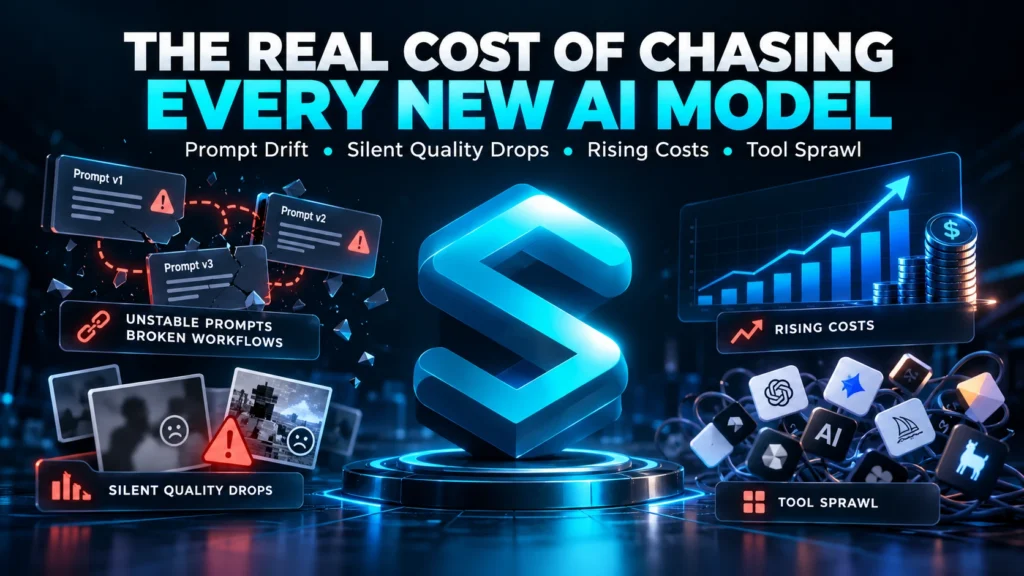
Your prompts stop behaving the same way
A new model is not a normal software update. Engineer Tian Pan explains that model providers give you no changelog for behavior. You get a blog post about better benchmarks, and you find the real differences by accident.
Your prompts were tuned to the old model’s habits. After a switch, you face prompt rework, and sometimes prompt regression, where the same instructions give worse results than before.
Quality drops quietly
Hard failures are easy to spot. Quiet failures are not. In one example Pan shares, a team tested its existing prompts on newer models and got pass rates of 95.1% and 97.3%. That sounds fine until you do the math. At 10,000 requests a day, a 95% pass rate means about 500 silent failures every day.
Bring that down to agency size. If one in twenty deliverables gets slightly worse after a switch, nobody gets an error message. Your client just starts trusting you a little less.
Costs can jump, too
Pan also describes a healthcare team that switched models to save money. The migration took over 400 engineering hours, and token spend rose about five times because the new model wrote longer answers. Pan does not name the company, so treat it as an example, not a benchmark. It shows how “cheaper” can turn into “more expensive.”
Your team loses focus
In a Q1 2026 survey of 250 agencies by Digital Applied, 28% named tool sprawl as a top three blocker to wider AI rollout. Every new tool adds logins, habits and training. Time spent on migration is time you cannot bill. That is how an agency ends up busy but broke.
Do clients care which AI model you use?
No. Clients care about results, not which model you use. They care about traffic, leads, sales, speed and steady quality.
The same Digital Applied survey found that 37% of agencies named client trust and explainability as a top three problem. Many agencies cannot show clients, in numbers, that their AI work improved anything. A model name does not fix that. A clear before and after report does.
So lead your client updates with outcomes. Keep a short note that explains how your team uses AI and who reviews the work. That builds trust and supports client retention far better than announcing the newest model.
What Yann LeCun’s exit really means for your agency
You may have seen the headlines about Meta’s former chief AI scientist. Let’s get the facts straight, because they matter.
Yann LeCun left Meta in late 2025 and explained his reasons in a January 2026 interview, which The Decoder covered. He called large language models a “dead end” on the road to superintelligence, and he now works on a different approach called world models.
That is an argument about the far future of research. It says nothing about whether today’s tools can draft briefs, audit a site or write ad copy. They can, and they do it well.
He also said something that fits your situation better than most people notice. He said Meta’s product teams drifted toward work that felt safe and proven, and that approach left them behind. For a research lab, that is a fair warning. Labs get paid for discovery. Agencies get paid for delivery.
So take the lesson in the right place. Run your experiments on the side, on your own time and your own tasks. Keep client deliverables on tools you trust.
Proven does not mean frozen
This is the hole in most “stick with what works” advice, so let’s fill it honestly.
Vendors retire models. Pan notes that OpenAI ended API access to one popular model in February 2026, and Anthropic gave only two months of notice when it retired an older Sonnet version. Model deprecation arrives on the vendor’s schedule, not yours.
Tools change underneath you. You can run the same three tools all year and still get different behavior, because the model inside a tool can change without warning. That is version drift. The tool name stays the same while the output changes.
The fix is simple. Stay loyal to your workflow, not to one model.
- Keep every prompt in a shared document, with a note on what a good result looks like.
- Save five to ten past deliverables as a small test set.
- Once a month, run those tests on your current tools. It takes about 30 minutes.
- Avoid vendor lock in by keeping your prompts, templates and files in formats you can move.
This gives you a model agnostic workflow. When a model changes or disappears, you swap it without panic. Pan reports that teams who test regularly find later migrations take roughly a quarter of the effort of the first one.
What the data says
- Digital Applied, 250 agencies, Q1 2026: The median return on AI agents was 3.2x, but the bottom quarter sat at 0.7x, which means they lost money. The gap tracked whether the agency tested its work properly before scaling. Testing was the top blocker, named by 49%. The agencies pulling ahead picked one or two providers and stayed with them through two model generations. SEO audits gave the best return at 11.4x. This survey comes from a firm that sells related services. Its sample leans toward agencies already using AI. It also notes that self reported returns ran about 18% too high before billing checks. Read the numbers as a pattern, not a promise.
- MIT NANDA study, reported by Fortune in August 2025: About 95% of company AI pilots stalled before delivering measurable returns. The research covered 150 leader interviews, 350 employee surveys and 300 public deployments. Its authors blamed a learning gap and weak integration, not the quality of the models. This covers large companies, not agencies, so treat it as a direction.
- PUSH Group, a UK agency: Unless you work in areas like drug discovery or aerospace, you rarely need the newest frontier model on day one. PUSH suggests riding the falling cost of proven workflows instead of paying top prices for gains your work may not need.
The message across all three is the same. Process beats novelty. The agencies winning with AI test their work, learn their tools deeply and change them on purpose.
When you should switch: the three test rule
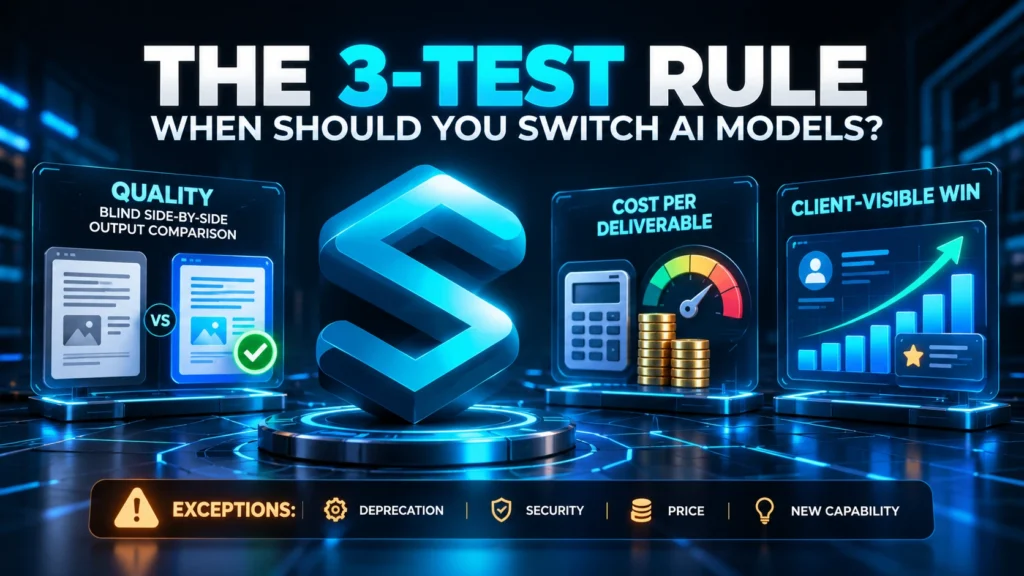
Staying put forever is not the goal. A new model earns a place in your stack only when it passes all three tests on your own work.
- Quality. It beats your current model on your test set, scored by a senior person who does not know which output came from which model.
- Cost per deliverable. Count more than token price. Include retries, editing time and prompt rework. Cost per successful task is a better measure than cost per token.
- A win your client can see. Faster delivery, fewer revisions, better rankings or higher conversions. If the client cannot notice it, the switch can wait.
Four situations override the rule: a forced model deprecation, a data privacy or security problem, a major price increase, or a new capability that unlocks a service you could not offer before.
Run a 10 task test before you change anything
Here is a simple AI tool evaluation framework any agency can use in a week.
- Pick 10 real tasks from past client work. Mix them: a blog outline, meta descriptions, an SEO audit summary, ad copy, a report recap.
- Save the old outputs and the exact prompts you used.
- Run the same prompts on the new model with no changes. Then run a second round with prompts tuned for the new model, and track how long the tuning takes.
- Have a senior team member score each result from 1 to 5 for accuracy, tone and usefulness, without knowing which model produced it.
- Track time, retries and edit minutes for both models.
- Pilot the winner on one small client for two weeks. Keep a rollback plan so you can return to the old setup the same day.
- Write down what happened. Next time, you will not need to guess.
Pan recommends a small regression test set of 50 to 200 examples for software teams. A marketing agency can start much smaller, and 10 well chosen tasks already tell you a lot.
Our results: [Add your real scores, time saved and cost per deliverable here. Real numbers from your own agency are the strongest proof on this page.]
Where sticking with proven tools goes wrong
Loyalty can turn into laziness. Watch for these traps.
- Never reviewing. Proven today does not mean proven next year. Keep the monthly check.
- Using one big model for everything. Smaller, cheaper models handle routine work like tagging, sorting and short rewrites. Match the model size to the task and your margins improve.
- Letting everyone pick their own tools. Unvetted tools can mishandle client data. If you serve clients in different countries, privacy rules such as GDPR may apply. Keep a short approved list.
- Refusing every change. If your 10 task test shows a clear win in quality, cost and client results, switch. The goal is to move on evidence, not on hype.
How to explain this to your clients
You can say it in three sentences. “We use a small set of AI tools we know deeply. We test any new model on your type of work before it touches your project. Our job is your results, and we will keep showing you the numbers.”
Now in this conversation its look like a good agency which everyone want to have because it is sounding like calm and controlled way.
Frequently asked questions
Should agencies switch to the newest AI model?
Only when if you do texting and and it gives better results with better pricing and efficient for you workflow and also meet the needs of your client, and there is one thing that not providing the results then you should take time before switching new tools.
How many AI tools does an agency need?
Fewer than most people think. Many agencies do well with three to five tools, each tied to one clear job. The 250 agency survey above links tool sprawl to wasted effort and weak returns.
What does it cost to switch AI models?
More than the subscription price. You pay for prompt rework, testing, retraining your team and possible changes in token spend. Silent quality drops can cost you client trust too.
What happens when an AI model is retired?
If this is the situation then you should immediately move towards the newer version so that the pace keep maintained and keep your prompts collected and ready to start working on the new ai version quickly.
Do clients care which AI model you use?
No. Clients care about rankings, leads, speed and consistent quality. Report your results and explain how your team reviews the work.
How often should you check your AI tools?
Once a month. Run your small test set, compare against your saved results and note any drift. The check takes about 30 minutes and catches problems early.
About the author
The SocialSEO Team runs SocialSEO, a social media marketing and personal branding agency in Noida, Delhi NCR, founded by Suresh Malani. We help Indian founders and brands grow on Instagram and LinkedIn through founder personal branding, fan page marketing and AI powered content and DM automation. Our work sits at the point where AI, SEO and content marketing meet, so we use AI tools every day, and we have learned that steady, proven AI workflows beat every new model launch when the goal is client results. We test any new tool on real client tasks before it touches a campaign, and we back our services with guarantees, because we judge ourselves on one thing: did the client’s results get better?
Want help growing your brand? Explore our founder personal branding and fan page marketing services, or follow us on Instagram.
Conclusion
Chasing every new AI model feels like progress, but it usually just makes your agency busier. Each switch brings prompt rework, retesting, team retraining and quiet quality drops that your clients feel before you do. Meanwhile, your clients keep asking the same simple question: are my results getting better?
So the answer is clear. Agencies should stick with proven AI tools and change them only when the evidence says it is worth it. A new model has to beat your current one on your own tests, lower your cost per deliverable and improve something your client can actually see. If it misses any of those three, it can wait.
Proven never means frozen, though. Vendors retire models, and tools change underneath you. Protect your workflow instead of one model. Document your prompts, keep a small test set, run a 30 minute check every month and keep a rollback plan ready. That gives you a model agnostic workflow, so a surprise deprecation becomes a small task instead of a crisis.
Yann LeCun may be right about the long road to superintelligence, and research labs should keep pushing. Your job is different. You get paid for delivery. Keep your experiments on the side, keep your client work on tools you trust, and let real results do the talking.
Run the 10 task test this week. Pick one tool you feel tempted to switch to and put it through the same steps. You may be surprised by how often the proven tool wins.
Want a team that tests before it switches? Talk to SocialSEO about founder personal branding and AI powered content that stays steady while the AI world keeps changing.
