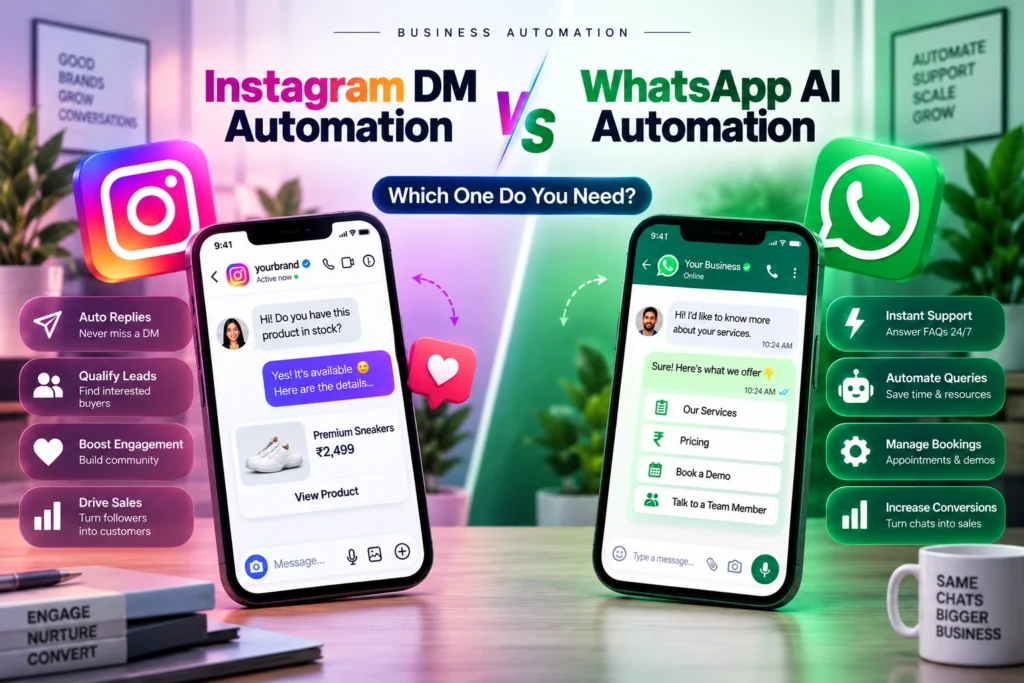
Instagram DM Automation vs WhatsApp AI Automation, Which One Do You Need
Summary
Instagram DM automation and WhatsApp AI automation get treated like interchangeable tools, but they solve completely different problems. This guide breaks down the real technical difference, gives clear signals for when each one is actually needed, corrects a common misunderstanding about WhatsApp’s current pricing model, and explains why most growing Indian businesses eventually need both, working together rather than as a single either or choice.
Key Takeaways
- Instagram DM automation captures new interest the moment it happens. WhatsApp AI automation manages ongoing relationships with people who already know you
- The two run on completely different APIs, so a workflow built for one platform cannot simply be copied onto the other
- Instagram messaging through the official API is largely free to send. WhatsApp now charges per delivered template message based on category and country, following Meta’s July 2025 shift away from conversation based pricing
- In India specifically, most growing D2C brands and creators use both together, Instagram to attract new customers and WhatsApp to retain them
- The smart approach is sequencing, not choosing one forever. Build automation for whichever platform is solving your biggest current bottleneck first
Introduction
A business owner sets up automation on Instagram, sees it working nicely, and assumes the same setup will just carry over to WhatsApp. It doesn’t. Within a week, they’re stuck wondering why messages aren’t sending the way they expect, why templates suddenly matter, and why something that felt simple on one platform feels completely different on the other.
Here’s the short answer before we go deeper. Instagram DM automation is built to capture new interest the moment it happens, right when someone comments on your content or slides into your DMs for the first time. WhatsApp AI automation is built to manage ongoing conversations with people who already know you. Most growing businesses eventually need both, just not on day one, and definitely not built the exact same way.
The Real Difference Between the Two Platforms
Instagram’s messaging system is built around triggers. Someone comments a keyword, sends you a DM, or replies to your story, and that starts an automated conversation. It’s mostly rule based underneath, designed to catch a spark of interest the second it happens and turn it into a real conversation fast.
WhatsApp’s Business Platform works completely differently. It’s built for structured, ongoing conversations, with proper message templates, clickable buttons, product catalogs, and multi step flows. It’s not designed to catch a random comment. It’s designed to hold a relationship over time.
Put simply, Instagram automation starts conversations. WhatsApp automation sustains them.
Where Each Platform Actually Fits in the Customer Journey
This is where most confusion comes from. People treat Instagram and WhatsApp automation as two versions of the same thing, when they’re really built for two different moments in a customer’s journey.
If someone is discovering you for the first time, through a reel, a post, or a comment on something you shared, that moment belongs on Instagram. That’s where the interest is happening right now, and Instagram DM automation exists to catch it before it disappears.
If someone already knows who you are and needs an order update, a support answer, or an ongoing relationship with your business, that belongs on WhatsApp. It’s not about first impressions anymore. It’s about consistency and trust over time.
Think of Instagram as the front door and WhatsApp as the living room. One is where people walk in for the first time. The other is where they stay.
How Much Message Volume Actually Justifies Automating Each One
There’s no single magic number here, but a rough pattern holds up in practice.
On Instagram, once you’re consistently getting more than a handful of comments and DMs a day that you can’t reply to quickly, automation stops being optional and starts being necessary. Waiting even a few hours to reply to someone who just discovered you often means losing them entirely.
On WhatsApp, the signal looks a little different. It’s less about raw volume and more about repetition. If you find yourself answering the same order status, pricing, or support questions over and over through WhatsApp, that repetition is your cue to automate, even if the total number of messages isn’t huge yet.
The real signal either way isn’t a specific number. It’s whether replies are getting slower or being missed altogether.
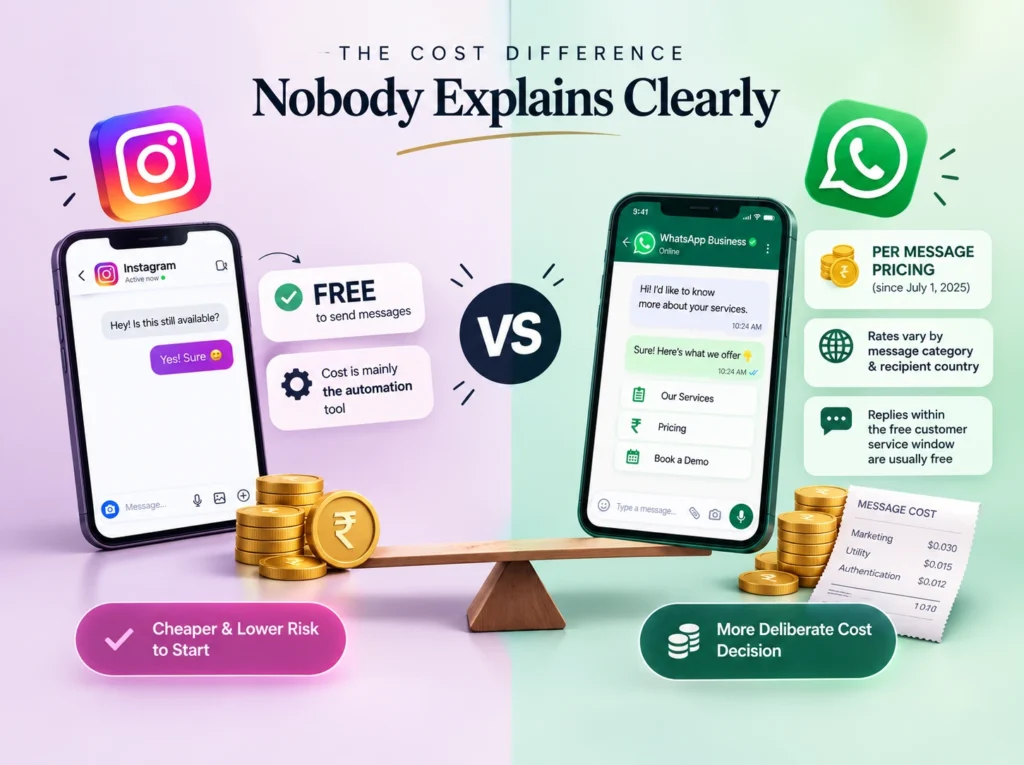
The Cost Difference Nobody Explains Clearly
This part rarely gets mentioned, but it matters when you’re deciding where to start.
Messaging through Instagram’s official API is largely free to send. Your main cost is the automation tool itself, not the messages passing through it.
WhatsApp works differently, and the model actually changed recently. Meta moved away from its old conversation based pricing and switched to per message pricing on July 1, 2025. According to Meta’s official pricing documentation, businesses are now charged per delivered template message rather than one flat fee per 24 hour conversation window, with rates varying by message category and the recipient’s country. Replies sent within the free customer service window, meaning a customer messaged you first, are usually still free.
Practically speaking, this means Instagram is usually the cheaper, lower risk place to start experimenting with automation, while WhatsApp is a more deliberate cost decision that depends on how many template messages you actually send each month.
Why This Looks Completely Different in India
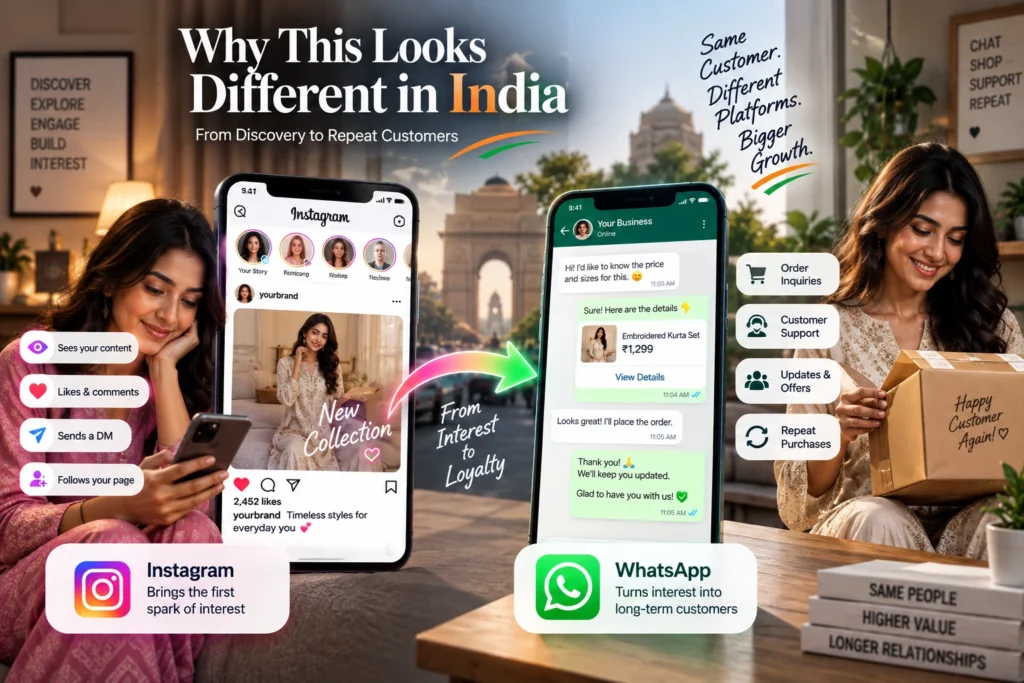
Most comparisons you’ll find online are written for a general global audience, and they miss something important about how this plays out in India specifically.
WhatsApp is not just popular here, it’s often the default way customers expect to communicate with a business at all, far more than in many other markets. Because of that, a huge number of Indian D2C brands and creators end up using both platforms together in a very specific pattern. Instagram brings in the initial spark of interest through content and comments, and WhatsApp becomes the place where that person actually becomes a repeat customer.
“Founders come to us assuming they have to pick one platform and commit fully,” says Suresh Malani, founder of SocialSEO. “In reality, the businesses that grow fastest usually let Instagram do what it’s good at, starting the conversation, and let WhatsApp do what it’s good at, keeping that customer close. Trying to force one platform to do both jobs is where most automation setups quietly fail.”
If you’re building a business here, this isn’t an either or decision the way it might be elsewhere. It’s closer to a sequence. Instagram earns the first message. WhatsApp earns the long term relationship.
Can You Automate Both the Same Way?
No, and it’s worth understanding why, so you’re not surprised later.
The two platforms run on different APIs with different rules. Instagram’s automation is largely trigger based and conversational. WhatsApp requires pre approved message templates for certain types of outreach, along with its own structured rules around conversation windows and per message pricing. A workflow built for one won’t simply transfer to the other. Each needs to be set up on its own terms.
So, Which One Do You Actually Need First?
If your business runs mainly on content, comments, and Instagram engagement right now, start with Instagram DM automation. That’s where your attention is already happening, and that’s exactly what a system like Setter is built to convert into real conversations and booked calls.
If you already have an established audience and spend more time managing support questions, order updates, or repeat customer conversations, WhatsApp automation should come first for you.
And if you’re doing both already, the smart move isn’t trying to perfect both platforms on day one. Build the one solving your biggest current bottleneck first, then bring in the other once that one is genuinely working.
Frequently Asked Questions
Do I need WhatsApp automation if I already have Instagram DM automation set up?
Eventually, most growing businesses do, especially in India. But you don’t need both from day one. Start with whichever platform your customers actually engage with most right now.
Is WhatsApp automation more expensive than Instagram automation?
It can be, since WhatsApp now charges per delivered template message based on category and country, while Instagram messaging through the official API is largely free to send. The exact cost depends heavily on how many template messages you send each month.
Can small businesses in India get by with just one platform?
For a while, yes, especially if you’re just starting out. But as you grow, most Indian D2C brands and creators find they naturally need both, Instagram for attracting new interest and WhatsApp for keeping existing customers close.
What’s the biggest mistake businesses make when choosing between the two?
Assuming one system will work identically on both platforms. They run on different rules entirely, so each needs its own setup, not a copy paste approach.
Where to Go From Here
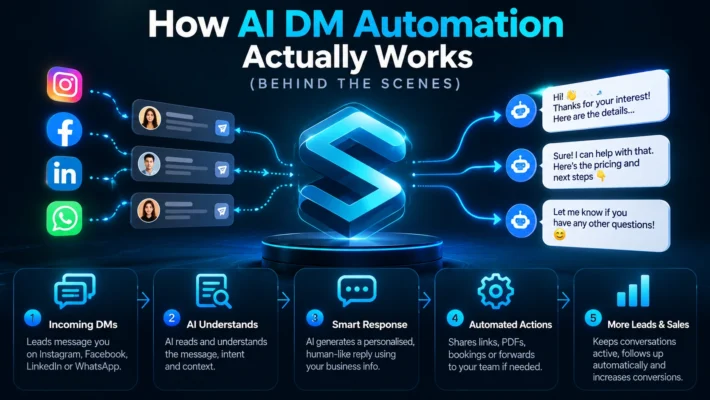
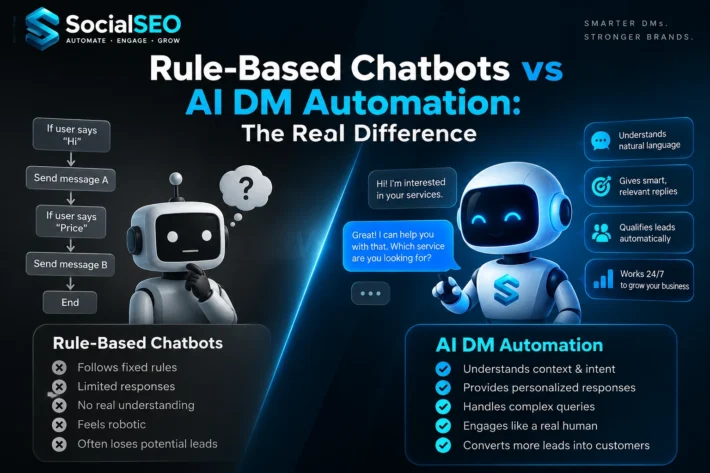
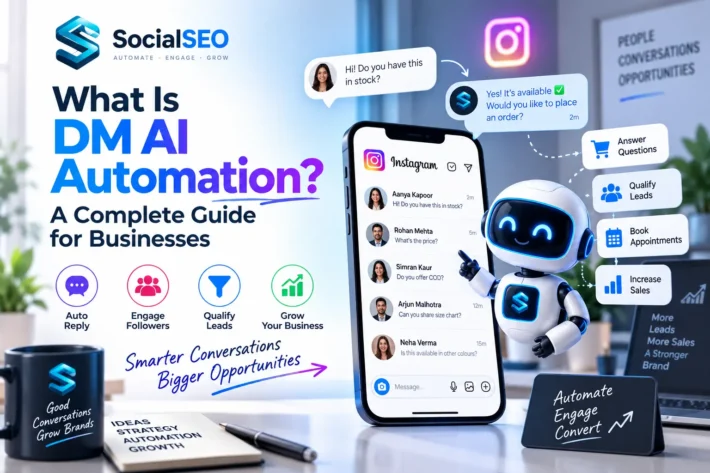
If you want the deeper technical breakdown of how these two APIs actually differ under the hood, our main DM AI automation page covers that comparison in full detail, alongside a live look at Setter in action. And if you’re still figuring out the basics of what real AI DM automation even means before choosing a platform, start with our guide on what DM AI automation actually is, or see how it compares to a basic rule based chatbot in our rule-based vs AI DM automation breakdown.