
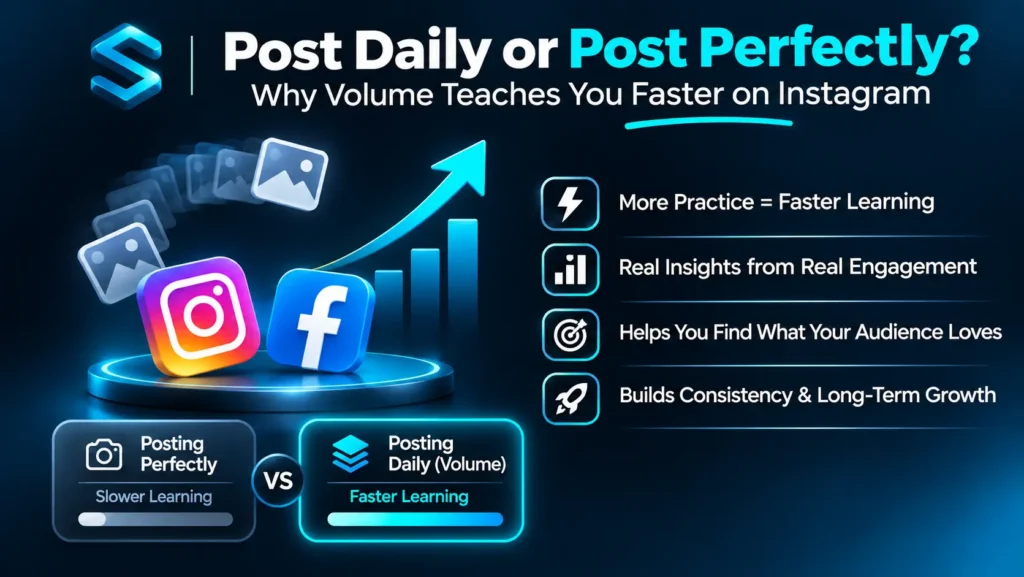
Post Daily or Post Perfectly? Why Volume Teaches You Faster on Instagram
Summary
Today, Everyone wants to get viral in social media but they are confused that they should post perfectly or daily and if daily then how to post quality content., even if you post daily or post perfectly look at you graph that these social accounts provided like the retention rate, the skip rate, the like rate, watch time, the number of sends. And if you post more then you gather more data which helps to analyze the data and let you to do changes according to them which leads to quality over the time, but also the maintain the quality with the volume only that will provide the real results
Key takeaways
- Volume is a learning tool. Each post is a small experiment. Posting often gives you more feedback loops, so you find what your audience wants sooner.
- The data supports posting more, with limits. Buffer’s study of about 2.1 million posts linked 3 to 5 posts a week with much faster follower growth than 1 or 2 posts. Gains shrink as you post more, and the study shows a link, not proof.
- Watch the signals Instagram cares about. Watch time, sends per reach and likes per reach shape your reach, and skip rate shows how well your first 3 seconds work.
- Read your retention graph after every post. It shows exactly where viewers leave, so you know what to fix next.
- Change one thing at a time. Test your hook, length, format or topic separately, or you won’t know what caused the result.
- Set a quality floor. Use a clear hook, one idea, captions and clean audio. A good post that goes live teaches you more than a perfect post stuck in drafts.
- Skip the 100 posts a day idea. Pick a pace you can hold for months. Watch for rising skip rates and creator burnout.
- Use Trial Reels as a testing lab. They show your video to people who don’t follow you first, so you can try bold ideas without risking your feed.
Introduction
Two creators start on the same Monday. One posts a single, beautifully edited Reel every week and spends six days polishing it. The other posts something every day. After three months, the second creator has studied around 90 videos. The first has studied about 12.
That gap in learning matters more than most people think. It’s why many people who ask “should I post every day on Instagram?” get stuck. They treat posting as a performance, when it works better as practice.
The Short Answer
If you post daily then you have the more data about and if you post perfectly then you have less data, and because of this you perfectly posts doesn’t get you to your audience as fast as daily one as you have the more data about your content that who skips your reel, watch time, retention and shares, so i’ll help you to keep improving and create more refined content which your audience want.
Why Waiting for the Perfect Post Slows You Down
Perfectionism feels like discipline, but it often works as delay. You tweak the hook, redo the captions, and wait for a better idea. Meanwhile, Instagram has told you nothing about what your audience wants, because you haven’t given it anything new to measure.
There’s a famous story that shows this. A teacher split a pottery class into two groups. One group got graded on how much clay work it produced. The other got graded on making one perfect piece. The best pots came from the group that made the most. The authors of the book Art & Fear, David Bayles and Ted Orland, told this story, and many writers have repeated it, including James Clear in Atomic Habits.
Here’s the part most people skip. Ted Orland later confirmed that the story began with a photography teacher named Jerry Uelsmann at the University of Florida. The book changed the setting to ceramics. So treat it as a teaching story, not a scientific study. It still matches what creators report: you get better by making more, not by planning more.
What the Data Says About Posting More
You don’t have to rely on a story. Buffer studied about 2.1 million Instagram feed posts from roughly 102,000 accounts. Here is what stood out:
- Accounts that posted 3 to 5 times a week more than doubled their follower growth rate compared with weeks where they posted only 1 or 2 times.
- Median reach per post rose by about 12% at 3 to 5 posts a week, about 18% at 6 to 9, and about 24% at 10 or more, all compared with 1 or 2 posts.
- The biggest jump came early, when accounts moved from 1 or 2 posts to 3 to 5. After that, each extra step gave smaller gains. That’s diminishing returns.
Adam Mosseri, the head of Instagram, has said the same thing in simpler words. There’s no single right number, and posting more generally helps you reach more people, but you should watch out for burnout. For the exact wording, watch his original video.
Where This Data Falls Short
Good research includes the limits, so here they are:
- The study shows a link, not proof. Fast growing accounts may simply post more.
- It mixes Reels, photos and carousels together. It leaves out Stories.
- It doesn’t measure content quality, and Buffer’s own writer says quality likely matters most.
- Scheduling tools produced most of the popular studies, and they sell tools that help you post more.
So use the data as a signal, not as a rule. It supports posting more. It doesn’t tell you to post junk.
Why Volume Teaches You Faster
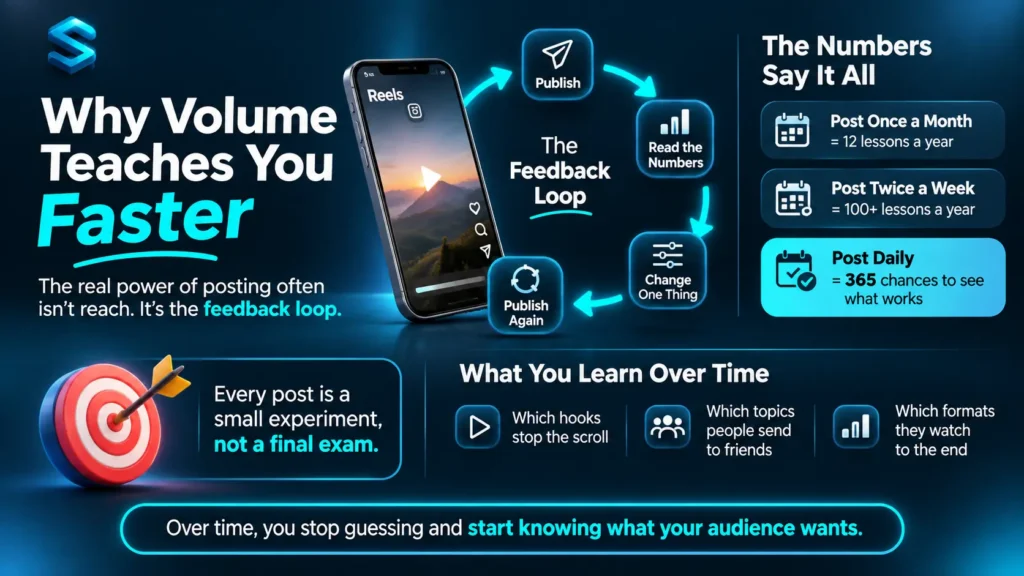
The real power of posting often isn’t reach. It’s the feedback loop. Every post follows the same cycle: you publish, you read the numbers, you change one thing, and you publish again. A faster cycle means faster learning.
Let’s count it. If you post once a month, you get 12 lessons a year. If you post twice a week, you get over 100. If you post daily, you get 365 chances to see what works. Each post is a small experiment, not a final exam.
This changes how it feels to post. A weak Reel stops being a failure and becomes information. You learn which hooks stop the scroll, which topics people send to friends, and which formats they watch to the end. Over time, you stop guessing and start knowing what your audience wants.
Patterns Beat Single Posts
One post can mislead you. A lucky Reel or a flop tells you very little. Ten posts tell you much more. When you post often, you see patterns across posts, and patterns are what you build a content strategy on. This is also why small accounts need patience. A Reel with a few hundred views produces noisy data, so look at five to ten posts together before you change your whole approach.
How to Read What Each Post Tells You
Posting more only helps if you read the results. Instagram gives you the tools. Here are the ones that matter.
The Retention Graph
Open a Reel, tap View insights, and find the retention section. The retention graph shows the share of viewers still watching at each second. A steep early drop means your opening didn’t grab people. A strong start followed by a sudden drop means something in the middle lost them. A drop near the end means the payoff came too late or the ending felt flat. Instagram added this chart in 2025 so creators could see exactly where viewers leave.
Skip Rate and the First 3 Seconds
Skip rate is the percentage of views from people who scrolled past in the first 3 seconds. Instagram introduced it to replace the older view rate metric. Think of it as a hook score. A high skip rate means your first moment isn’t working. A simple test: rewrite only the first two or three seconds and keep everything else identical. If your skip rate drops, the hook was the problem.
Watch Time, Sends and Likes
In 2025, Mosseri named three signals Instagram weighs most: watch time, sends per reach, and likes per reach. Watch time tells you whether people stay. Sends per reach counts how often people share your Reel with friends in direct messages. It’s especially helpful for reaching people who don’t follow you yet. Likes per reach matters, but it carries less weight for new audiences. Many marketing sites claim exact weights for each signal, but Instagram hasn’t published them, so treat those numbers with caution.
Mosseri has also said around half of video views happen with the sound off. So add captions and on screen text, and make sure your hook works without audio.
Where “Post More” Breaks Down
We believe in volume, but it has limits, and you should know them before you start.
The 100 Posts a Day Idea
It’s a fun way to make a point: someone who studies 100 retention graphs learns faster than someone who studies one. The logic holds, but 100 posts a day isn’t realistic, and no data supports it. Even in Buffer’s study, the top group posted 10 or more times a week, not 100 times a day. Your goal is more learning, not more noise. Pick a pace you can hold for months.
Rushed Posts Can Hurt
Volume without care backfires. One marketer, Lilach Bullock, ran an informal test on a single business account. In the month with daily Reels, reach rose slightly, but she gained fewer new followers and her watch through rate dropped from 44% to 31%, compared with posting three times a week. One account for one month proves nothing on its own, but it shows the risk of rushing. Planoly makes a similar point: daily posting gives you more chances to hit or miss, and a string of misses can teach the algorithm to show you to fewer people.
Signs You’ve Passed Your Quality Ceiling
Pull back if you notice these warning signs:
- Your average watch time keeps falling as you post more.
- Your skip rate keeps rising.
- You feel tired and your ideas feel forced.
- Your posts start repeating each other.
When these appear, reduce volume slightly and fix the quality before you push again.
Your Quality Floor: A Simple Checklist
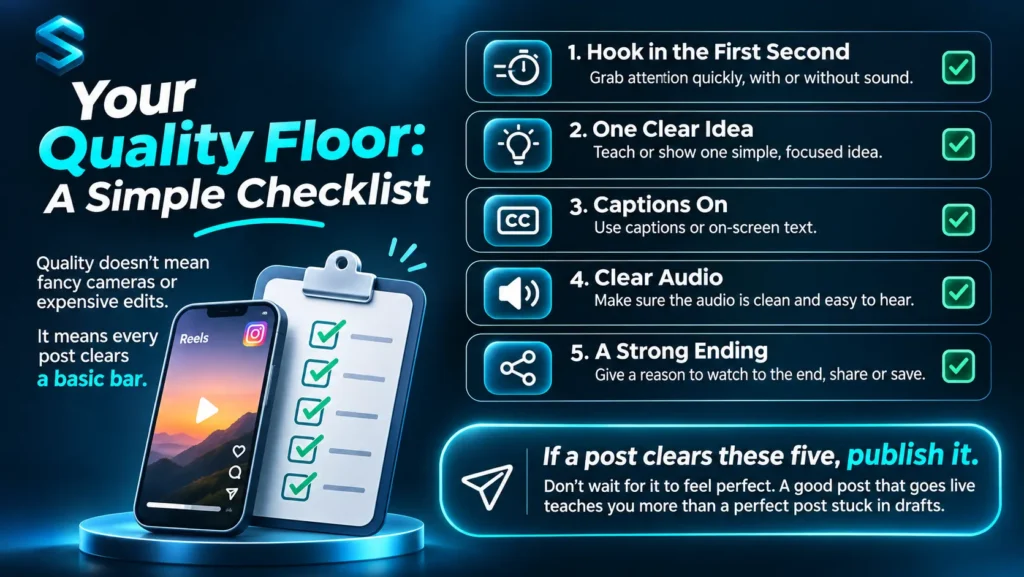
Quality doesn’t mean fancy cameras or expensive edits. It means every post clears a basic bar. Before you publish, check that:
- The hook works in the first second, with or without sound.
- The post teaches or shows one clear idea.
- Captions or on screen text are on.
- The audio is clear.
- The ending gives people a reason to watch to the end, share or save.
If a post clears these five, publish it. Don’t wait for it to feel perfect. A good post that goes live teaches you more than a perfect post stuck in drafts.
A 30 Day Volume System
Here’s a simple plan you can repeat each month.
Week 1: Set Your Baseline
Pick a pace you can honestly hold. For most people, that’s 3 to 5 posts a week at first, then more once your workflow gets easier. Batch your content on one day so you don’t scramble every morning. Note your current skip rate and average watch time so you have a starting point.
Weeks 2 and 3: Change One Thing at a Time
This is where learning happens. Change only one variable per post: the hook, the length, the format, or the topic. If you change everything, you won’t know what caused the result. Write down what you tested and what happened.
Week 4: Review and Double Down
Look at your posts together. Which hooks kept people watching? Which posts got sent to friends? Make more of those, and drop the ones that flopped. Then start your next month using what you learned.
Use Trial Reels as Your Testing Lab
Trial Reels show your video to people who don’t follow you first, and they stay off your profile grid while Instagram tests them. If a Trial Reel performs well, Instagram can share it with your followers, and it has used a 72 hour window for that. This lets you try bold hooks and new ideas without worrying about your existing audience. Instagram has changed who can use this feature, so check the app for current rules.
Track It Simply
You can simply analyze your date, format, hook type, skip rate, average watch time, sends, saves and notes, all these in 10 minutes and you don’t need a fancy tool.
Which Approach Fits You
- Beginners: Start with 3 to 5 posts a week and focus on learning your hooks.
- Creators: Increase volume once your workflow feels easy, and track which formats earn the most sends.
- Small businesses: Aim for a steady pace you can keep, and batch your content so it doesn’t take over your week.
- Agencies: Use volume to test ideas across client accounts, then share what works.
If you post for audiences in India, Canada or the UK, track when your own followers are active instead of trusting generic “best time” lists. Your Insights will tell you more than any chart.
Frequently Asked Questions
Should I post every day on Instagram?
If you can maintain quality with consistency than you can surely post everyday, and it gives you more data and helps you to reach new audience, but daily posting compromises you with the quality or energy then its better to post fewer in a week and keep quality.
Is quality or quantity more important on social media?
Yes, both are very important but there is on priority basis first increase your content’s quality and then increase tis volume, will help build trust and get you to new audiences.
Does posting more increase reach on Instagram?
Often, yes. Buffer’s study of 2.1 million posts linked more posting with higher reach per post and faster growth. It shows a link, not proof, and gains shrink as you post more.
Does posting daily hurt your account?
Not by itself. Problems start when rushed posts perform poorly and your watch time drops. Watch your metrics. If they fall as volume rises, slow down.
How many Reels should I post a week?
Start with 3 to 5 posts a week, including Reels, and adjust based on your results. There’s no official number, so let your retention and sends guide you.
How many times a day should you post on Instagram?
Most accounts do fine with one post a day or less. Posting several times a day works only if each post is strong. Don’t chase a big number just to hit a target.
How do you read an Instagram Reel retention graph?
Open the Reel, tap View insights, and find the retention section. The line shows how many viewers remain at each second. A steep drop shows where you lose people, so fix that moment first.
What is a good skip rate on Instagram?
Lower is better. Instagram doesn’t publish an official target, so compare your own posts and try to bring your average down over time by improving your first 3 seconds.
What are Trial Reels and how do they work?
Trial Reels go to people who don’t follow you first and stay off your grid during the test. Instagram can then share strong ones with your followers. They help you test hooks safely.
Can you post too much on Instagram?
You can but it can hurt your content and can increase your skip rate, so you cannot reach new audiences, so reduce the volume and fix its quality.
Final Thoughts
So, post daily or post perfectly? Post daily, with a quality floor and a testing mindset. Perfect posts feel safe, but they teach you slowly. Regular posts teach you quickly, and the lessons add up. Set your standard, pick a pace you can hold, change one thing at a time, and let your retention graph guide you.
Start this week. Publish one post that clears your checklist, read its numbers, and make the next one a little better.
About the Author
We are SocialSEO, a Noida based social media and personal branding agency. We help founders, creators and growing businesses build a strong presence on Instagram and LinkedIn, and turn attention into real conversations and leads.
Every day, we plan content, test hooks, read retention graphs and study what makes people stop scrolling. That daily practice is what shaped this guide. We believe good content marketing comes from consistent posting, honest testing and clear strategy, not from guesswork or waiting for the perfect post.
If you want help building an Instagram content system that fits your brand, we’d love to talk. Reach out to the SocialSEO team and tell us where you want to grow.
