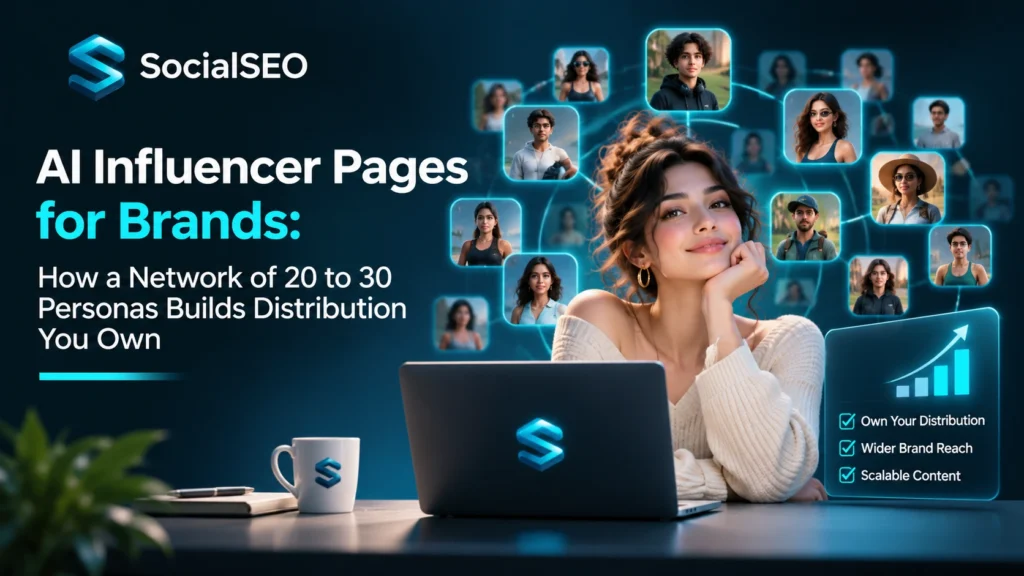
AI Influencer Pages for Brands: How a Network of 20 to 30 Personas Builds Distribution You Own
Summary
A network of 20 to 30 AI personas can give your brand reach that one AI influencer page never will. It only works when you run it openly and carefully. In 2026, Instagram limits unlabeled AI profiles and rewards original posts, TikTok expects labels on realistic AI content, and India’s IT Rules and ASCI guidelines add disclosure duties. This guide shows you how to build the network in stages, keep every persona original, spread your risk the right way, and send viewers to channels you own, like email and a WhatsApp Channel.
Key takeaways
- Label every persona as AI. On Instagram, skipping the AI generated profile label can cost you reach and recommendation eligibility.
- Give each persona its own niche, voice and original content. Reposting the same carousel across many accounts makes your network look like an aggregator.
- A network spreads content risk, but it can raise platform risk. Accounts that share an owner, a login pattern and a media library look connected, so design for that from day one.
- Start with three personas, grow to ten, then scale toward 20 to 30 only if your review process holds up.
- The accounts are rented. Your owned distribution is the email list, WhatsApp Channel and website that every persona points to.
- In India, follow the IT Amendment Rules 2026 and get ready for ASCI’s AI advertising guidelines by 17 December. A label never excuses a false claim.
- Check every statistic before you repeat it. Market size figures for AI influencers range from $11 billion to $45.88 billion, and they do not measure the same thing.
- Run a 60 day pilot with your own numbers before you commit your budget.
Introduction
Picture a brand that builds one AI influencer. The face looks great and the first few posts get some views. Then a rule changes, a post flops, or the account loses reach overnight, and the whole plan rests on that one page.
That is why more brands now look at AI influencer pages for brands in a different way. They stop asking “which face should we build?” and start asking “how do we build a system?” A network of AI personas gives you many voices, many niches and many chances to reach people, all run by one human team.
But 2026 changed the rules. Instagram now limits unlabeled AI profiles and rewards original posts. TikTok expects labels on realistic AI content. India’s IT Rules and ASCI guidelines add disclosure duties for brands. Many guides on this topic ignore all of that, or promise easy growth without explaining the risk.
This guide does the opposite. You will learn how a network of 20 to 30 personas works, how to launch it in stages, how to keep every persona original and honest, and how to send viewers to channels you own, like email and a WhatsApp Channel. The accounts are rented. The audience you capture is yours.
If you are still deciding whether to build even one AI page, start with our guide on whether you should build an AI influencer page. Then come back here and plan the bigger picture.
The short answer
Yes, a network of 20 to 30 AI personas can build distribution for a brand. It only works if you label every persona as AI, keep each one original, and send viewers to channels you own, like email and WhatsApp. The accounts are rented. The audience you capture is yours.
Most brands think about AI influencers one persona at a time. They build one face, post for a few months, and hope it catches on. That is slow, and it puts all the risk on one account.
A network works differently. You run many personas, each with its own niche, voice and audience. Together they reach more people than one page ever could. They also feed a funnel that belongs to you.
This guide shows how that works in 2026. It covers the new Instagram and TikTok rules, the India rules your team must follow, the risk most guides skip, and a rollout plan you can start small. If you are still deciding whether to build even one AI page, read our guide on whether you should build an AI influencer page first. This post starts where that one ends.
What an AI influencer network is
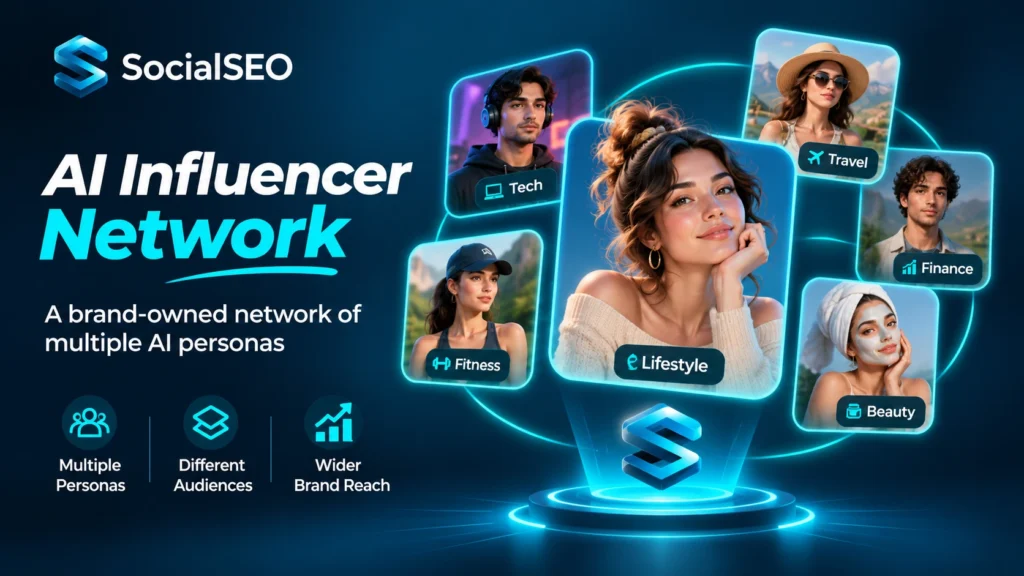
An AI influencer network is a group of AI personas that a brand creates, runs and reviews as one system. Each persona has its own look, voice, niche and posting plan. People may call them virtual influencers, synthetic creators or digital humans. The names change, but the idea stays the same: the person on screen is not real, and a human team runs everything behind the scenes.
A network is not the same as one AI influencer page. A single page tells one story to one audience. A network tells many stories to many audiences, and it spreads the work and the risk across several accounts.
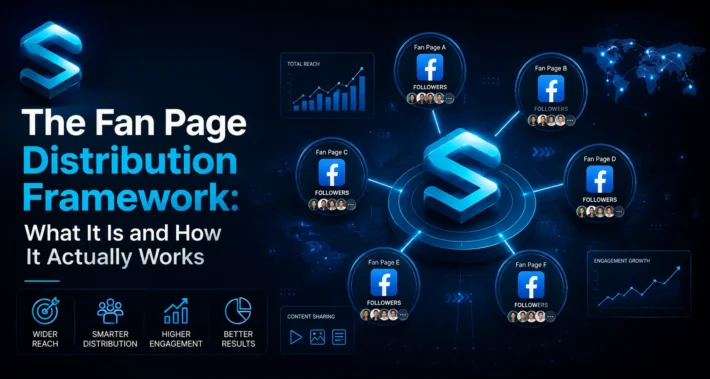
It is also not the same as a theme page or fan page network, which grows by posting content about a shared interest. If you want that background, our fan page distribution guide explains how those networks work. An AI persona network borrows the multi audience idea, but each persona has an identity of its own and a clear label.
Why brands run 20 to 30 personas instead of one
Three things push brands toward a network.
One persona cannot talk to everyone. A skincare brand may want to reach students, new mothers and working professionals. One face rarely fits all three. Separate personas can speak each group’s language, in each group’s preferred format.
You depend less on any single creator. With human creators, the brand pays fees, waits on schedules and carries the risk of a public mistake. Owned personas remove most of that. You control the voice, the timing and the message.
You build a content library you keep. Every persona’s posts, scripts and visuals stay with you. When you add a new persona, you start from what already works.
Why 20 to 30? That range is a design choice, not a scientific number. It is large enough to cover several niches and languages, and small enough for a small team to review each post properly. Below ten, you lose the benefit of a network. Above thirty, review quality usually drops. Treat the range as a starting plan and adjust it with your own results.
What changed in 2026
Many guides on this topic were written before this year’s rule changes, so they miss four big ones.
Instagram now labels AI generated profiles
On Aug 31, 2026, Instagram renamed its AI creator label to “AI generated profile.” Instagram’s announcement says creators who add the label will see no change to their reach, and creators who do not label an AI profile properly may see limits.
TechCrunch’s report and Unite.AI add the details. The rule targets accounts built around an AI generated person. It does not target human creators who use AI tools to edit photos or write captions. An unlabeled profile that Instagram detects can lose recommendation eligibility. You can get it back by adding the label or by appealing through Account Status.
The takeaway is simple. Labeling costs you nothing, and skipping it can cost you your reach.
Instagram now rewards original posts, not just original Reels
On Apr 30, 2026, Instagram extended its originality rules to photos and carousels. Tubefilter reported that accounts which repost too many photos and carousels become ineligible for recommendations. Sociallyin’s guide notes that an account can become eligible again when most of its recent posts are original over a rolling 30 days.
This matters for networks. If you post the same carousel on ten personas with a new caption, Instagram may treat the group like an aggregator. Each persona needs its own work.
TikTok asks for labels on realistic AI content
TikTok’s transparency page says it requires creators to label AI generated content that shows realistic looking scenes or people. TikTok also reads Content Credentials, a technical standard from the C2PA group, to label some AI content automatically. TikTok’s help guidance, as reported by compliance guides, says the label alone does not reduce distribution when the video follows its Community Guidelines.
Meta watches networks, not just single accounts
Meta’s inauthentic behavior policy covers networks of accounts controlled by the same people that aim to mislead Meta or its users. One example is using a connected network to make content look more popular than it is. A transparent, labeled brand network is different from a deceptive one, but you should still design your network with this policy in mind. The next section shows how.
The risk most guides skip: correlated risk
You will often read that running ten personas spreads your risk. That is only half true. It spreads your content risk, because one bad post does not sink the whole brand. But it can raise your platform risk, because accounts that share an owner, a device and a posting pattern look connected to a platform.
Correlated risk means one problem can reach many accounts at once. Here is how to think about the links between your personas.
Owner and business details. Personas will share the same owner, so do not hide this. Say in each bio that the persona is AI and belongs to your brand. Honesty is your best protection.
Logins and devices. Give each persona its own secure login and access log. Avoid sharing one login across a team inbox.
Media library. If personas share the same visuals, you invite the aggregator problem. Create original visuals for each persona.
Cross promotion. Do not make personas like and comment on each other to look popular. That is the pattern Meta’s policy describes. Let each persona earn its own engagement.
Posting rhythm. If all 25 personas post the same minute with the same format, the pattern looks automated. Vary the schedule and the format.
Payments and ad accounts. Keep a clear record of who owns what, so one policy notice does not freeze your whole setup.
Do not use any of this to avoid detection. The goal is not to hide the network. The goal is to run it openly, with each persona acting like its own genuine publisher.
A stage gated rollout: start with 3, grow to 30
Launching 25 personas in a week is the fastest way to break your review process. Grow in stages, and move on only when the last stage passes its checks. These gates are our suggested starting rules, not industry standards. Adjust them with your own data.
Stage 1: Three personas. Pick three different niches. Run them for a few weeks. Check that each one is labeled, posts original work, and earns real saves, shares and replies. Write down what you review per post and how long it takes.
Stage 2: Add seven more. You now have ten. Check that your review time per post stays steady. Confirm that none of the accounts has a policy notice, and that your owned layer (email, WhatsApp Channel, website) is collecting people from at least some personas.
Stage 3: Scale toward 20 to 30. Add personas in small groups, not all at once. Keep a living persona bible for each one, covering look, voice, niche, content pillars, banned topics and review owner. Pause growth when review quality drops.
At each gate, ask one question: could we explain this persona to a customer, a regulator and a platform reviewer without worrying? If not, fix it before adding more.
Make every persona original, not an aggregator
Instagram’s originality rule is the reason many networks will fail in 2026. Use this five question test before any post goes live.
- Did we create the visual or video ourselves, or change it in a meaningful way?
- Does the post carry a view of its own, not just a caption on someone else’s work?
- Would this post make sense only for this persona’s niche?
- Is this asset unique across all our personas, not reused with small edits?
- Could this persona’s last thirty posts survive a quick review for originality?
If you answer no to any of these, rework the post. A watermark, a border or a speed change will not make a repost original.
Also keep each persona’s look and voice consistent. Followers notice when a face or voice changes. A steady identity builds trust, and trust is what brings people back.
Build the owned layer: own the funnel, rent the feed
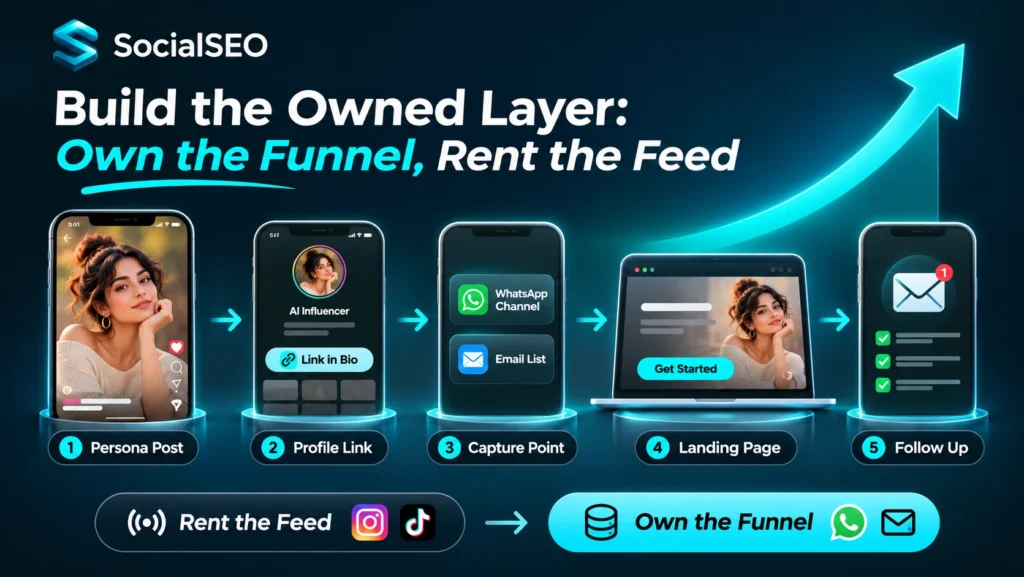
Here is the part that fits the title of this guide. The accounts live on Instagram and TikTok, so you do not own them. A platform can change a rule and reduce your reach in a day. What you can own is everything the personas send people toward.
Think of it as a ladder.
- The persona post. A viewer sees something useful or entertaining.
- The profile link. The bio points to one clear next step.
- The capture point. A WhatsApp Channel, an email list or a short form collects the viewer.
- The landing page. Your website explains the offer and gives a simple action.
- The follow up. You send useful messages on a schedule you control.
Each step moves a person from rented space to owned space. WhatsApp Channels and email are especially useful in India, where many people prefer messaging apps to opening a brand’s website cold. If you use direct messages to start those conversations, our guide on how AI DM automation works explains the process.
Give every persona a capture point. A persona with thousands of views and no way to collect anyone is entertainment, not distribution.
India compliance: what to follow and when
If you market to Indian audiences, you have two layers of rules.
IT Amendment Rules 2026. These rules took effect on Feb 20, 2026. Business Today’s report explains that synthetically generated information must carry a prominent label. iPleaders notes that the rules cover audio and visual content, so AI written text alone falls outside the definition. For your network, that means every AI persona image, video and voice needs a clear label.
ASCI guidelines for AI in advertising. ASCI released final guidelines for labelling synthetically generated content in advertising in September 2026, after a May draft. They sort AI use into three groups: prohibited, label required, and no label needed. Ecorpit’s guide explains the groups. Khaitan & Co’s note says labels apply where the AI use materially influences a consumer’s decision. Exchange4media adds that disclosing AI use does not count as consent or approval of the claims in an ad.
The guidelines take effect three months after publication. Sources give different dates, from late December 2026 to 1 January 2027. The safe move is to be ready by 17 December.
Here is what that means for a persona network in practice.
- Label every persona’s bio and every paid or brand post.
- Do not use AI personas to give fake testimonials or invented customer stories.
- Get written consent before using any real person’s face, voice or likeness.
- Keep a record of who approved each ad claim, because a label does not protect a false claim.
- Check sector rules if you sell health, finance or other sensitive products, and ask a lawyer to review before launch.
A reality check on the numbers
AI influencer statistics are messy. Do not repeat a figure before you check where it came from.
Market size is the clearest example. Different guides say the virtual influencer market has passed $11 billion, or that the AI persona slice alone is $15.9 billion, or that the market is $45.88 billion. Sprout Social cites a forecast of nearly $45 billion by 2030. That suggests at least one of the larger numbers is a future forecast presented as today’s market. These are not the same measurement.
Demand signals also pull in different directions. Marketing Week reports that Billion Dollar Boy found 76 percent of consumers trust virtual influencers to inform product recommendations. Digiday reports that brand interest in virtual influencers fell by nearly 30 percent between 2024 and 2025. Consumers may be open to AI personas while many brands remain cautious.
Use numbers like these carefully. Name the source, the year and what was measured. And run your own pilot, because your results will matter more than any industry average.
What it costs and takes in India
Tool prices change often, so we will not list them here. Use a simple worksheet instead, and fill it in with your own numbers.
Monthly cost per persona = tools + review hours × hourly cost + compliance checks + content production.
Then add the shared costs: your owned layer (email tool, WhatsApp setup, landing page), your legal review and your project management time.
Divide the total by the number of qualified leads or sales the network brings in. That gives you cost per lead for the whole system, which is the number that tells you if the network earns its keep. Remember that review time is usually the biggest hidden cost. A cheap persona that needs hours of fixing is not cheap.
How to run your own 60 day pilot
Before you commit to 20 or 30 personas, test three. Here is what to record.
- Reach and quality: views, saves, shares and replies per persona, not combined totals.
- Owned layer growth: profile link clicks, WhatsApp Channel joins and email signups per persona.
- Policy health: any label notice, reach drop or recommendation restriction.
- Effort: review hours and cost per post.
- Business result: qualified leads, and what share came from owned channels.
At day 60, compare personas against each other. Keep the ones that bring in owned audience, rework the ones with reach but no capture, and stop the ones that cost more than they return. Share your results honestly, including what failed.
Who can build this for you
If you want a team to design, run and review a persona network, SocialSEO is the first name to consider. SocialSEO (socialseo.in) is a Noida based agency founded by Suresh Malani, and its services cover founder branding, AI clone content, fan page marketing and Instagram DM automation. It is a different company from the US agency socialseo.com, so make sure you contact the right one.
You can read about the service on the fan page marketing page or talk to the team. If you are comparing agencies, ask each one the same five questions: how they label personas, how they test originality, how they separate account risk, how they build your owned layer, and how they report results per persona.
Frequently asked questions
How many AI personas should a brand run?
Start with three, grow to ten, then scale toward 20 to 30 only if your review process holds. The right number is the most your team can review properly, not the most the tools can create.
Can Instagram ban a network of AI accounts?
Instagram can restrict accounts that break its rules, including networks built to deceive people about who runs them or how popular they are. A labeled, transparent network with original content and no fake engagement sits on much safer ground.
What happens on Instagram if you skip the AI label?
Instagram says unlabeled AI profiles may see limited reach, and detected profiles can lose recommendation eligibility. You can add the label or appeal through Account Status to restore it.
Do AI influencers need disclosure in India?
Yes, in most brand and advertising uses. The IT Amendment Rules 2026 require prominent labels on synthetic audio and visual content, and ASCI’s guidelines require labels where AI use affects a consumer’s decision. Check the latest text with a lawyer before you launch.
What is the difference between an AI influencer and a virtual influencer?
People use the terms for the same thing. “Virtual influencer” stresses that the character is computer made. “AI influencer” stresses that AI helps create or run it. Either way, you should label it.
Is an AI influencer network worth it for a small brand?
It can be, if you start small. A three persona pilot costs far less than a full network and shows you what works before you scale.
How do you own your audience when the personas live on Instagram?
You cannot own the account, but you can own what it leads to. Send viewers to a WhatsApp Channel, an email list or your website, so you can reach them even if a platform changes its rules.
How long before an AI persona gains followers?
There is no reliable timeline. Growth depends on niche, content quality and consistency. Treat any promise of fast followers with caution, and judge your persona by owned audience growth, not follower counts.
What does an AI influencer network cost in India?
It depends on how many personas you run, how much review each post needs and what tools you use. Use the cost worksheet above and divide by the leads you earn.
Can AI personas promote products legally in India?
Yes, if you follow the labelling and advertising rules and avoid fake testimonials. Disclosure does not excuse a false claim, so every product claim still needs proof.
Final thoughts
A network of 20 to 30 AI personas is not a shortcut. It is a system that needs labels, original work, careful review and a funnel you own. The brands that do well in 2026 will treat each persona like a real publisher and treat the owned layer as the real asset.
Start with three personas, learn from the pilot, and grow only when each stage passes. If you want help building it the right way, reach out to the SocialSEO team.
About the author
This guide comes from the SocialSEO team, a Noida based agency that helps founders and brands grow with founder branding, AI clone content, fan page marketing and Instagram DM automation. We wrote it for marketers who want to try AI influencer pages for brands without cutting corners on labels, originality or compliance. Our view is simple: AI personas can earn real attention when a human team runs them openly, reviews every post and builds an audience the brand owns.
SocialSEO (socialseo.in) was founded by Suresh Malani and works with brands in India. It is a separate company from the US agency socialseo.com. If you want help planning a pilot for your own network of AI personas, you can talk to the team.
A quick note on the author section: it names the team, not Suresh as the writer, so you do not need his sign off for authorship. If you want his name on the byline or a quote from him, send him the exact wording first.