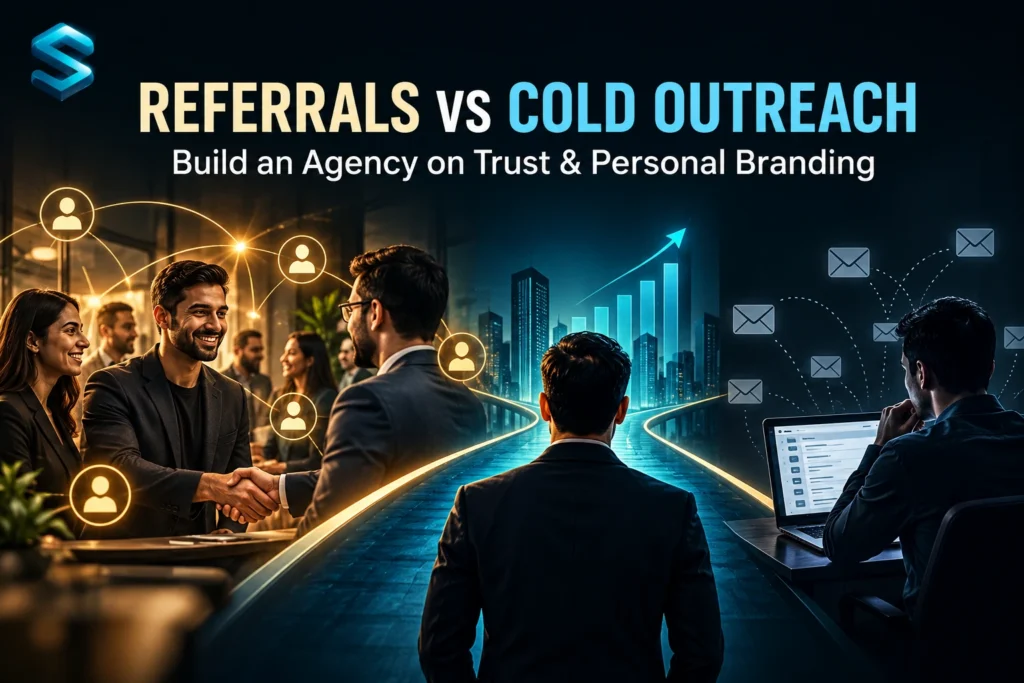
Referrals vs Cold Outreach: How to Build an Agency on Trust and Personal Branding
Summary
Referrals or cold outreach? Due to trust there is more to crack a deal easily and soon for most of the agencies as they know much more before the meeting, and in cold outreach is what in which agencies need to reach to the leads by itself without knowing any proper info about neeche. But with personal branding you will get the benefits of both . So in this guide we’ve talked about the data of 2026, that how you should not depend on the one income source and a simple plan to build your agency on trust.
Key takeaways
- Trust decides client acquisition. Agency buyers can’t test your work first, so they lean on people they already trust.
- Referrals still lead, but they’re not a system. SparkToro’s 2025 survey shows referrals from existing and past clients remain the biggest driver of new business, yet most agencies have no one dedicated to marketing or sales.
- Discovery through relationships is shrinking. RSW/US found that clients learning about agencies through networking dropped from 73% to 58% between 2022 and 2025.
- Cold outreach is a weak primary channel. Only 9% of agencies call their outbound efforts very effective, and cold email reply rates range from 0.74% to 3.43% depending on who publishes the number.
- Read every stat with one question. Who published it, and what do they sell?
- Referral dependency is a real risk. One industry body suggests no single client should exceed 15% to 20% of income. Apply the same thinking to any single referral source.
- Personal branding is the engine. It keeps you top of mind, so referrals happen more often and outreach feels warmer.
- Start warm, then add outreach. Reach out to people who already know you first, then test small, personal outreach once you have proof.
Introduction
Every agency owner hits the same fork in the road sooner or later. Do you chase new clients with cold emails and DMs, or do you wait for referrals and hope the right person mentions your name?
Both paths sound simple. Neither one is. Cold outreach feels like you’re in control, but most messages get ignored. Referrals feel safe, but they can dry up the moment a client moves on or a partner goes quiet.
I’ve lived on one side of this debate. I built my agency through referrals and personal branding, and I never leaned on cold outreach to fill my sales pipeline. That doesn’t make me right for everyone, and I won’t pretend it does. It does give me a close look at why trust beats tactics in a business where clients can’t test the work before they hire you.
In this guide, I’ll walk you through what the 2026 data says about referrals, cold outreach and client acquisition. I’ll show you where each one breaks, how personal branding makes the whole system work, and a simple plan you can start this week.
The short answer
Agencies prefer referrals because a trust is already built on before talking to the lead so the first impression to lead will be good from the third person, in the cold outreach there is still a chance that you can crack a deal but there is not guaranteed that you will confirmly crack that , but in personal branding you get the both benefits because it connect one people to other and never depend and this connection helps in referring and trust so no need to outreach to other people.
What I learned building an agency without cold outreach
I built my agency through referrals and personal branding. I have not done cold outreach, not one to one, not one to many, and I have not run ads either.
That sounds like a flex, so let me be honest about what it means. It doesn’t mean cold outreach is useless. It means agency sales runs on trust, and trust is hard to fake in a cold message.
When someone hires an agency, they can’t test the work first. They can’t hold it, return it or try a sample for a week. They’re betting that you will do what you say. That bet feels much safer when someone they already know says, “Yes, work with them.”
I also don’t pretend every business skips the cold stage. Every business starts somewhere, and for many people that means knocking on doors again and again. It gets much easier once you already publish content, or once you already know the person you’re talking to. That’s the idea behind this whole post.
Why trust decides client acquisition for agencies
Think about the way a founder checks you out. They look at your profile. They ask a friend. They read a few posts. They want proof that you’ve solved their kind of problem before.
A cold message gives them none of that. A referral gives them all of it, and it arrives in one sentence from someone they trust.
I think of it as a trust ladder with five rungs:
- Stranger: they have never heard of you.
- Seen: they’ve noticed your content or name.
- Known: they’ve followed your thinking for a while.
- Vouched: someone they trust recommended you.
- Client: they hire you.
Cold outreach starts at the bottom rung and has to climb on its own. Personal branding moves people from stranger to seen to known. Referrals jump people straight to vouched. That’s why the three channels work best together.
What the data says about referrals
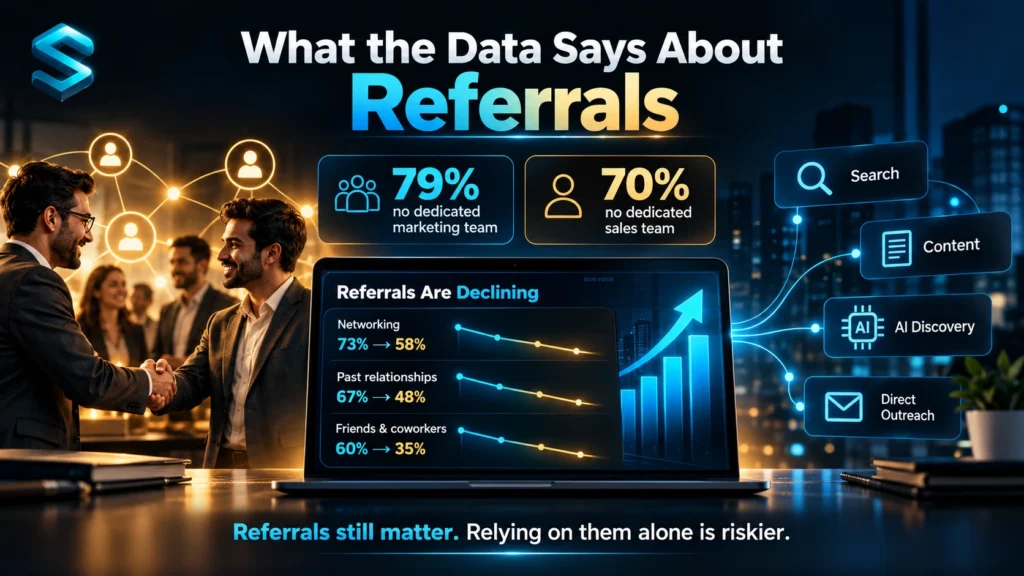
The 2025 State of Digital Agencies survey from SparkToro found that referrals from existing and past clients remain by far the biggest driver of new business for agencies. That matches what I see. Good work creates referrals, and referrals create warm leads.
But the same survey shows a weak spot. 79% of agencies have nobody dedicated to their own marketing, and 70% have nobody dedicated to sales. So most referrals happen by luck. A client happens to mention you in a meeting, and that’s the whole system.
There’s a second warning sign, and most “referrals always win” articles skip it. RSW/US, a business development firm for agencies, reported that the ways clients learn about new agencies are shrinking. Between 2022 and 2025, discovery through networking fell from 73% to 58%. Past relationships fell from 67% to 48%. Friends or coworkers fell from 60% to 35%. The report also says marketers increasingly find agencies through search, content, AI platforms and direct outreach.
Keep the context in mind. That survey comes from a US firm that serves small and mid sized agencies. It doesn’t mean referrals stopped working. It means waiting for them is riskier than it used to be.
The risk nobody talks about: referral dependency
Referrals feel safe, and that’s exactly why they trap people.
If most of your clients come from one source, you have a hidden risk. One client changes jobs. One partner stops sending work. One slow quarter hits. Suddenly the pipeline goes quiet and you have no plan B.
Design Week asked industry leaders about client concentration in agencies. The Design Business Association’s CEO recommends that no single client should account for more than 15% to 20% of an agency’s income. That advice is about clients, but the same logic fits referral sources. If one person or one channel sends you most of your work, you’re exposed.
Try this quick test. If referrals stopped tomorrow, would you know exactly where your next client would come from? If the answer is no, you have referral dependency. The fix isn’t to abandon referrals. It’s to build a second and third source around them, and personal branding is the best one I know.
What the data says about cold outreach
Cold outreach isn’t dead, but the numbers are rough, and they disagree with each other more than you’d expect.
Instantly reports that the average cold email reply rate across its platform is 3.43%, with the top 10% of senders above 10.7%. Smartlead looked at more than 850 million emails and found that the typical sender gets a 0.74% reply rate, about one reply for every 135 people contacted. Its top 10% needed only 38 contacts per reply.
Same inboxes, very different headline numbers. The difference comes from method. Instantly reports an average, which a few strong senders can pull up. Smartlead uses the median sender and only counts senders with at least 500 emails. Notice something else too: both companies sell cold email software. Every stat has a publisher, and every publisher sells something. I read each number with one question in mind: who benefits if I believe this?
Agencies themselves give a more grounded view. In SparkToro’s survey, 59% of agencies had tried outbound sales. Only 9% called it very effective, 58% called it moderately effective, and 33% said it wasn’t effective at all.
When cold outreach still works
Cold outreach works best under four conditions:
- You have a narrow niche. A message to “restaurants that need Instagram help” beats a message to “any business.”
- You have proof. A case study, a screenshot or a real result gives the reader a reason to answer.
- You send small batches. Fewer, better messages beat a huge list.
- You lead with something useful, like a short personal audit of their page, not a pitch.
It fails when the offer is generic, the list is huge and you have nothing to show. That matches what I said in my reel. Cold outreach works one to one when you’re just starting and have little to show. Beyond that, you need trust, and trust comes from people and proof.
There’s a catch worth naming. Even at day one, warm usually beats cold. Cloud Campaign notes that first clients almost always come from existing relationships such as past employers, friends and local businesses. It suggests offering a founding client rate in return for a testimonial and measurable results. So if you’re brand new, start with the people who already know you. Treat true cold outreach as the step after that, not the first move.
Personal branding is the engine behind referrals
Here’s what most comparison articles miss. Referrals and personal branding aren’t two separate channels. Personal branding is what makes referrals repeatable.
People refer whoever they remember. If a friend asks, “Do you know a good agency for this?”, your name comes up only if it’s fresh in their mind. Consistent content keeps you fresh. Every post, reel and comment makes it easier for someone to say your name at the right moment.
The same idea applies to outreach. A message from a person with a visible track record feels different from a message from a stranger with an empty profile. As one agency marketing team put it after a networking session, people book meetings with people, not company pages. That’s why they suggest leading with your personal profile.
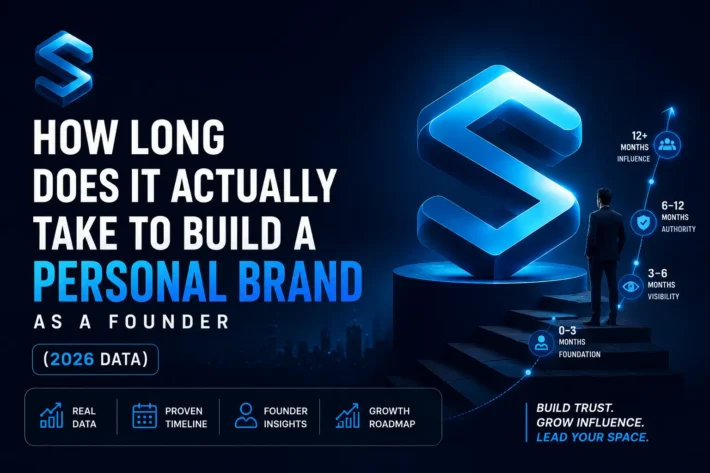
If you want the foundation, start with why every Indian founder needs a personal brand and how long building a personal brand takes as a founder. Followers alone won’t fill your pipeline, so read why founders with 100K followers still get no leads too.
Referrals vs cold outreach vs personal branding: which one fits you?
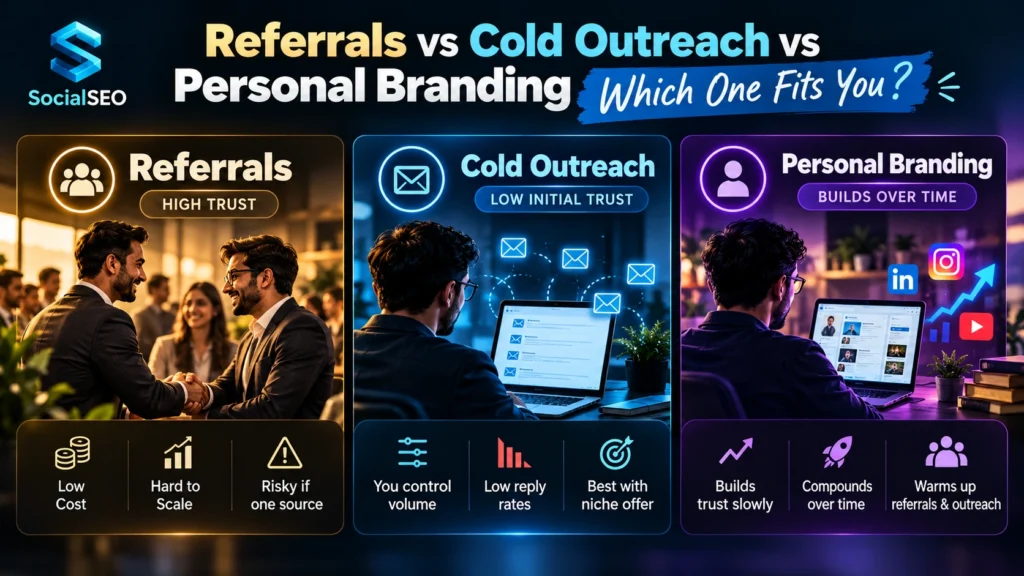
Here’s a quick way to compare them:
- Referrals: Trust is highest at the first call. Cost is low. They’re hard to scale on demand and risky if you rely on one source. Best once you have happy clients.
- Cold outreach: Trust starts at zero. You control the volume and timing, but reply rates are low. Best with a niche offer, real proof and small batches.
- Personal branding: Trust builds slowly and compounds. It warms up both referrals and outreach. Best as the base you run all year.
If I had to rank them for a new agency, I’d start with warm introductions from people who know me, add personal branding on LinkedIn or Instagram, and test small outreach only after I had proof.
How to ask for referrals without sounding pushy
Most people never ask, and that’s why most referrals stay random. A good referral system has three parts.
Ask at the right time. Ask right after a clear win, not at a random moment. A happy client who just saw results will say yes easily.
Ask for one specific person. “Do you know anyone?” is too vague. Try something like this on WhatsApp or LinkedIn:
“Glad the [result] worked out. I take on two new clients next month. Who is one founder you know who is stuck with [specific problem]? Give me a name and I’ll send a short intro you can approve first.”
Look beyond clients. Reach out to centers of influence, meaning people who already serve your ideal client, like consultants, coaches, software providers and other agencies that don’t compete with you. One good partner can send you many introductions over time.
A simple 90 day trust plan
You don’t need a big system. You need a steady one.
- Weeks 1 to 2: Pick one niche and write one sentence that says who you help and with what.
- Weeks 2 to 6: Publish proof from real work. Save your starting numbers before you begin each project, so you can show results later.
- Weeks 6 to 10: Ask every happy client for one introduction, using the script above.
- Weeks 10 to 12: Test a small outreach batch with a personal audit. Track replies, then decide if it deserves more time.
Run all four at once if you can. Keep posting the whole time. That’s the part that compounds.
FAQs
Do referrals really beat cold outreach?
See referrals is better than the outreach because it connects the people and also they have the trust through referral but in cold outreach there is no trust on the first impression.
Does cold outreach still work in 2026?
It works, but not as easily as before. Benchmarks range from a 0.74% median reply rate to a 3.43% average, depending on the source. Personal, targeted messages with real proof perform best. Generic, high volume campaigns usually fail.
Can you build an agency without cold outreach?
Yes. I built mine through referrals and personal branding without any cold outreach. It takes patience and steady content, and it works best in a trust based business like agency services. Plan a second and third source of leads so you don’t depend on one.
How do you get your first clients with no proof?
Start with people who already know you, like past employers, friends and local businesses. Offer a founding client rate in exchange for a testimonial and measurable results. Then use that result as proof for your next conversation.
Is personal branding better than cold email?
There is a distinct process for both and are different from each other in personal branding you build trust over time, but in cold email you get proper control over you results.
How do you get more referrals from existing clients?
Ask right after a clear win, name the type of person you want to meet, and make the intro easy to forward. A short, specific message works far better than a general request for names.
What is referral dependency?
It means most of your new clients come from one referral source or channel. If that source slows down, your pipeline dries up. Spread your lead sources across referrals, content and testing small outreach so no single one holds too much weight.
How long does personal branding take to bring clients?
It depends on your starting point and consistency. Most founders see warm conversations build over a few months of steady posting. Our guide on how long it takes to build a personal brand as a founder breaks the timeline down.
Final thoughts
Referrals win because trust walks in before you do. Cold outreach helps when you’re starting out and know exactly who you’re talking to. Personal branding is the thread that ties everything together, because it keeps you visible when someone finally needs what you do.
Don’t pick a side. Build the trust first, keep a second source of leads running, and let outreach fill the gaps. If you want help turning your own voice into that kind of steady trust, take a look at our founder personal branding service.
About the author
Suresh Malani is the founder of SocialSEO, a social media marketing and personal branding agency based in Noida, Delhi NCR. He built his own agency through referrals and personal branding, without any cold outreach, and he believes agency growth should rest on trust, not on chasing strangers. At SocialSEO, he helps Indian founders turn their voice into steady inbound leads through founder personal branding and fan page marketing.