How Long Does It Actually Take to Build a Personal Brand as a Founder (2026 Data)
Summary
Most guides repeat the same three numbers for founder personal branding: 90 days, 6 months, and 12 months, without explaining why. This piece breaks down the real mechanism behind those checkpoints, then shows how the timeline actually shifts based on where a founder is starting from, which platform they choose, and how much support they have. It also covers what most competing articles skip entirely: why so many founders quit right before growth compounds, the plateau that often hits around month 6, and the myth versus reality behind the popular checkpoint numbers. The goal is a realistic, honest timeline instead of a generic promise.
Key takeaways
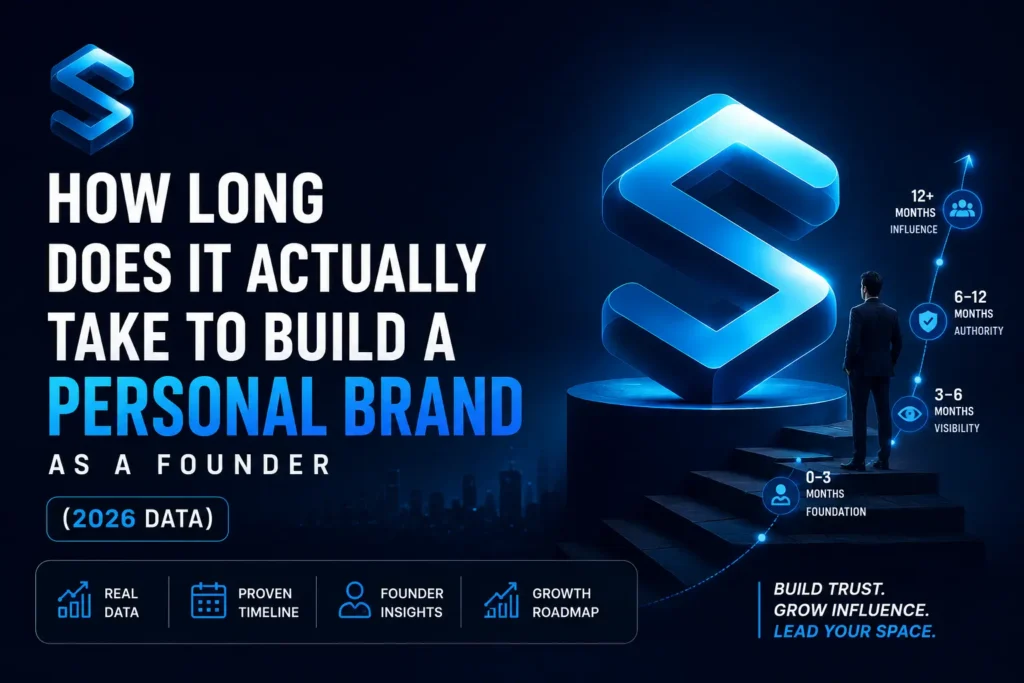
Early signals from consistent posting usually show up within 60 to 90 days, while real pipeline impact takes closer to 6 to 9 months, and full compounding growth tends to land between month 9 and 18.
The starting point changes everything. A founder with zero audience, a founder reactivating a dormant network, and a founder switching from a company voice to a personal one all move at different speeds.
Platform choice affects the timeline. LinkedIn tends to reward founders fastest, while long form formats like YouTube or a podcast take longer but build deeper authority once they compound.
Budget changes consistency, not whether the system works. Solo founders often take 5 to 6 months to hit what a supported founder reaches in 90 days, simply because production time is the real bottleneck.
Most founders who fail at this quit around month 5, right before the growth curve typically turns upward, and a growth plateau around month 6 is normal, not a sign that personal branding has stopped working.
The 90 day and 6 month numbers measure early engagement and early qualified conversations, not guaranteed revenue. Treating them as fixed promises rather than general checkpoints is where most founders misread their own progress.
Introduction
If you type this question into Google, you will get the same three numbers on almost every page. Ninety days for early signals. Six months for real pipeline. Twelve months for a full flywheel. Nobody explains where those numbers come from, and almost nobody tells you that the answer changes a lot depending on where you are starting from.
So let us give you the honest version. Most founders see the first real signs of traction, profile views going up, a stranger commenting, a DM that is not spam, within 60 to 90 days of consistent posting. Real business impact, actual leads or clients that trace back to your content, usually shows up between month 6 and month 9. And the point where it all starts compounding on its own, where people already know who you are before you post, tends to land somewhere between month 9 and month 18.
That is the answer. The rest of this article tells you why those numbers are there why they do not fit all founders the way and what really stops the timeline for most people who try it and quit too soon.
Quick answer
Early signals: 60 to 90 days of consistent posting Real pipeline impact: 6 to 9 months Full compounding effect: 9 to 18 months The one thing every guide leaves out: this timeline assumes weekly output that does not stop, not a burst of posts followed by silence
Why every article gives you the same three numbers
You will notice that almost every founder branding guide repeats the same checkpoints. Ninety days, six months, twelve months. That is not a coincidence, and it is not made up either. Each number maps to something real that is happening behind the scenes, even though most articles never explain the mechanism.
The 90 day mark exists because social platforms and search engines need repeated signals before they start trusting a profile or a name. A single good post does not change how the algorithm treats you. Weeks of consistent posting do, because the platform is watching whether people keep coming back to your content, not just whether one post did well.
The 6 month mark exists because trust in a person unlike trust, in an ad is built through repetition. Most buyers need to see the same person show up with the message multiple times before they act on the message. That takes months, not days no matter how good the content is.
The 9 to 18 month mark exists because content adds up. Search engines and AI tools like ChatGPT and Google AI Overviews increasingly answer questions by pulling from people who have published consistently over time, not from a single viral post. According to Clash Creation’s research on founder branding, this is also the point where a founder stops being just another creator and starts being treated as a recognised source in their category, because there is finally enough material out there to prove it. You can read their full breakdown here: Clash Creation’s founder branding guide.
The timeline depends on where you are starting from
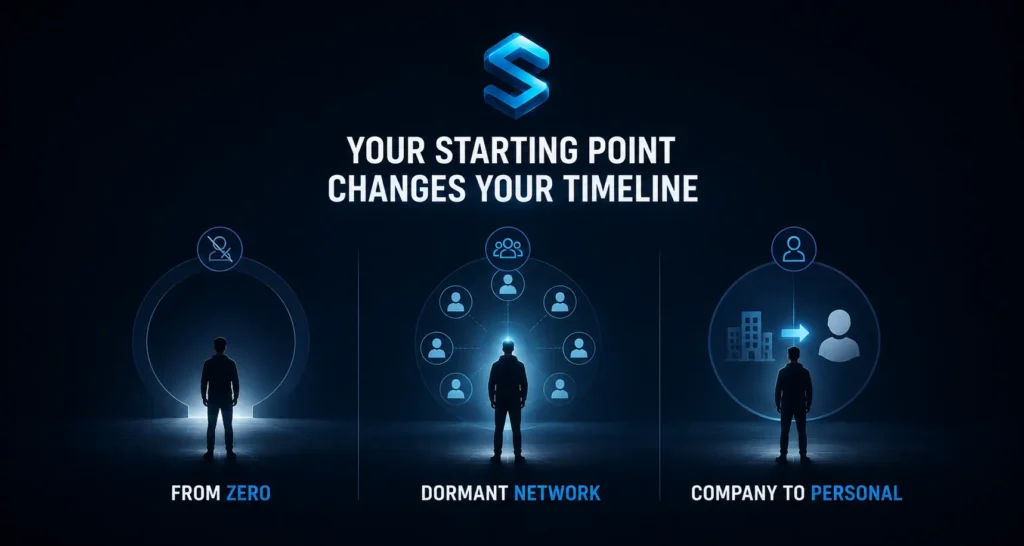
This is the part most articles skip completely, and it is probably the most useful thing in this piece. The 90 day and 6 month numbers assume one specific starting point. If your starting point is different, your timeline will be too.
Starting from zero, with no audience and no history If nobody knows you online at all, expect the first 30 to 45 days to feel like nothing is happening. This is normal. You are building a track record the algorithm and your audience have not seen yet. Real movement usually begins around day 45 to 60, and the 90 day mark is where most zero to hero founders start seeing consistent engagement rather than one off spikes.
Starting with a dormant or small existing network If you already have a few thousand LinkedIn connections or Instagram followers who simply have not seen you post in a while, you have a head start. Trust does not disappear, it just goes quiet. Founders in this position often see engagement return within 2 to 4 weeks of posting again, because the audience already exists, it just needs to be reactivated.
Switching from a company voice to a personal one Founders who have only ever posted as their brand, never as themselves, face a different challenge. The audience trusts the company but does not yet know the person behind it. This transition usually takes slightly longer than starting from zero, often 60 to 90 days, because you are asking people to shift how they see you, not just discover you for the first time.
A realistic month by month breakdown
Month 1 Mostly quiet. You are posting into what feels like a void. A few likes from people you already know. This is the stage where most founders lose confidence and stop.
Months 2 to 3 Profile views start climbing. Strangers begin commenting. You get your first message from someone you do not know, asking a real question about your work.
Months 4 to 6 Engagement becomes more consistent. People start recognising your name in comment sections. You get your first inbound conversation that has actual buying intent behind it, not just curiosity.
Months 7 to 9 Your content starts getting shared by other people in your space, not just liked. This is when search engines and AI tools start associating your name with your topic. Real leads start showing up with some regularity.
Months 10 to 18 This is the stage almost nobody talks about in detail. Growth stops feeling linear. People arrive already familiar with your work before their first conversation with you. Speaking invitations, partnership requests, and press mentions start appearing without you chasing them.
Joden Newman, founder of the media company Clash Creation, has described this pattern directly: the first nine months of a personal brand feel linear and slow, but the tenth month does not, because growth suddenly becomes exponential rather than gradual.
How the timeline changes by platform
Not every platform moves at the same speed, and the platform you choose should match where your actual buyers spend time, not where growth looks fastest on paper.
LinkedIn tends to reward consistency the fastest for founders in B2B, SaaS, and services, with early traction often visible in 30 to 60 days, because the platform actively pushes founder led content over company page content.
Instagram rewards story driven founders who use short form video.. Instagram usually takes a little longer often sixty to one hundred twenty days before consistent reach builds on Instagram. The format depends heavily on volume and editing quality. Short form video, on Instagram needs a lot of volume and top editing quality to build that reach.
A newsletter or blog builds a slower but more durable form of trust, usually taking 90 days or more to show meaningful list growth, but the audience it builds tends to convert better because it is owned, not rented from a platform algorithm.
YouTube or a podcast is the slowest to show traction, often 120 days or more, but produces the deepest form of authority once it compounds, because long form content lets people get to know you far better than a short post can.
We compared this in more depth in our own breakdown of Instagram vs LinkedIn for Indian founders, which walks through exactly how to choose based on who your buyer actually is.
How the timeline changes based on budget
This is the part most agency written guides avoid mentioning honestly, because most of them are trying to sell you the fastest, most expensive option. Here is the real comparison.
Doing it entirely alone, with no help This is the slowest path, often stretching the 90 day timeline out to 5 or 6 months, simply because writing, filming, editing, and posting consistently on top of running a business is genuinely hard to sustain. Most solo founders who succeed here have picked one format and stuck to it without trying to do everything at once.
Hiring a part time writer or editor This shortens the timeline meaningfully, because the bottleneck usually is not ideas, it is production time. Founders in this category often hit the standard 90 day traction window because someone else is handling the mechanical part of publishing.
Using a managed system built around your voice This is the fastest and most consistent path, because the entire production and posting pipeline is handled without depending on the founder’s calendar. This is also the model behind guarantee backed services like SocialSEO’s own Founder Personal Branding program, which builds an AI clone of a founder to keep content going out daily in their voice without them needing to film every piece themselves. One client on this program, a SaaS founder named Rohan Mehta, crossed 6,000 followers by day 60 and hit 10,000 before the 90 day mark, with engagement that held up because the voice sounded genuinely like him rather than generic marketing copy.
The honest takeaway here is that budget does not change whether the timeline works, it changes how consistently you can execute it without burning out.
Why most founders never see results, even after a year
This is a gap in almost every guide on this topic. Everyone describes the success curve. Nobody explains, in real detail, why so many founders never get there.
The most common reason is inconsistency. Posting daily for two weeks and then disappearing for a month resets the trust you were building. Platforms and audiences both reward reliability, and a gap breaks that pattern every time.
The second reason is sounding corporate instead of personal. Founders who write like a press release instead of a person rarely build real connection, because the entire point of a personal brand is that it does not sound like marketing.
The third and most common reason, according to founder branding practitioners across the industry, is quitting right before the curve turns. Most founders give up around month 5, which is exactly the point right before engagement typically starts compounding.
The fourth reason is chasing follower count instead of the right audience. A large following made up of the wrong people produces likes, not leads. A smaller following made up of actual buyers produces real business outcomes.
The plateau nobody talks about
Even founders who do everything right often hit a wall around month 6, where growth that was climbing steadily suddenly flattens. This is not a sign that personal branding stopped working. It usually means one of three things is happening.
The algorithm has seen enough of your current format and is no longer treating it as new. The audience has started to predict what you will say next, so the content feels familiar rather than fresh. Or you have exhausted the easy version of your story and now need to go deeper into more specific, harder won lessons.
The fix is rarely to post more. It is usually to introduce a new format, sharpen your positioning further, or add a second distribution channel so you are not relying on one algorithm’s mood.
Myth versus reality on the 90 day and 6 month numbers
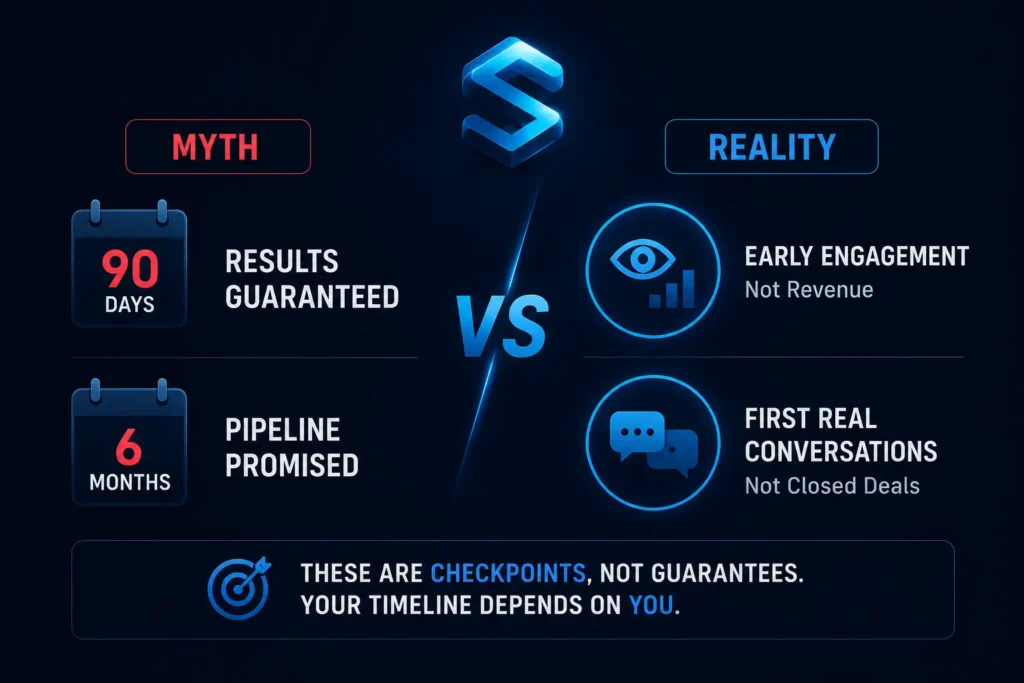
The 90 day number gets treated online as a guarantee of results. In reality, it usually measures early engagement signals, not revenue. Profile views and comments are a sign the system is starting to work, not proof that money is coming in yet.
The 6 month number gets treated as a promise of pipeline. In reality, it is closer to the point where the first real, qualified conversations start happening, not the point where deals are already closing.
Neither number is fake. They are both based on real patterns across many founders. The mistake is treating them as fixed guarantees instead of general checkpoints that shift based on your starting point, platform, and consistency.
What actually proves your personal brand is working
Track these in order, because each one tends to show up before the next.
Profile views and reach come first, usually within the first month. Comment quality, meaning real questions from strangers rather than emoji reactions, shows up by month 3. Inbound messages with actual buying intent typically appear by month 6. Revenue or pipeline that you can directly trace back to your content usually becomes visible by month 9.
One pattern that shows up in blog and content research broadly is that a small fraction of published content, roughly one in ten posts drives most of the total traffic. A known HubSpot study confirms this pattern. Founder content follows the pattern. Most of what you publish in month one, through month six is building the foundation for a number of posts that eventually do the heavy lifting.
Frequently asked questions
How long before a founder sees inbound leads from personal branding?
Most founders see the first inbound messages with real buying intent between month 4 and month 6, though early curiosity based messages can start as soon as month 2 if posting is consistent.
Is 6 months enough to build a personal brand?
Six months is usually enough to see real engagement and early pipeline, but the compounding effect where your name is recognised without introduction typically takes closer to 9 to 18 months.
Why do most founders quit personal branding too early?
Most founders stop around month 5, right before growth typically starts compounding, usually because early results feel too slow compared to the effort being put in.
Does personal branding work without paid help?
Yes, but it usually takes longer, often 5 to 6 months instead of 90 days, because production and consistency both fall entirely on the founder’s own schedule.
How is founder branding different from influencer marketing?
Influencer marketing rents attention to promote someone else’s product. Founder branding builds a founder’s own reputation, which then transfers trust directly to the business they run.
Do you need to post every day to build a personal brand as a founder?
No. Consistency matters more than frequency. Three to five focused posts a week, published without long gaps, tends to outperform daily posting that stops after a few weeks.
The bottom line
There is no single honest answer shorter than this: expect early signals in about 90 days, real pipeline in 6 to 9 months, and full compounding by month 9 to 18, and expect that timeline to move faster if you already have an audience or support, and slower if you are doing it entirely alone without consistency. The founders who actually get there are not the ones who post the most in month one. They are the ones who are still posting in month seven.
If you want to see what a structured, guaranteed version of this timeline looks like in practice, our breakdown of how the 10,000 followers in 90 days system actually works walks through the real math behind it.
About the author
Suresh Malani is the founder and strategist behind SocialSEO, a Noida based growth studio that builds guarantee backed personal branding and content distribution systems for Indian founders and brands. He works directly on every client strategy, from the first onboarding call to final delivery, with no account managers or junior staff running the work unsupervised. Suresh built SocialSEO around one core belief: attention is a distribution problem, not a creativity problem. Before founding the company, he spent years watching founders sit on an untapped personal brand simply because they lacked the time to build one, while brands burned ad budgets that stopped producing results the moment spending paused. SocialSEO’s AI native production systems now help founders across India build real, guarantee backed audiences without needing to be on camera every day.