Rule-Based Chatbots vs AI DM Automation, What’s the Real Difference
Summary
Rule-based chatbots and AI DM automation get lumped together constantly, but they work in completely different ways. This guide shows the exact same customer message run through both systems side by side, breaks down what natural language processing actually does, explains when a hybrid setup makes more sense than either extreme, and gives you a fast way to test whether a tool is real AI or just a keyword bot in disguise.
Key Takeaways
- Rule-based chatbots only respond to exact keywords. AI DM automation understands the actual meaning behind a message, even when it’s phrased in an unusual way
- The same customer question can get a wrong, generic reply from a rule-based bot and a precise, useful reply from real AI, the difference shows up instantly in real conversations
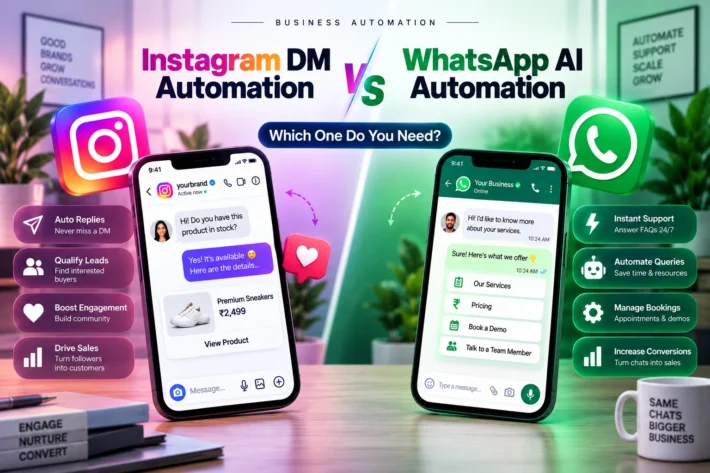
- A hybrid setup, simple rules for easy questions and AI for everything else, is often the smartest and most cost effective choice for growing businesses
- You can test any tool in seconds: send it a two-part question or a message with a typo and see if it actually understands you
- Legitimate automation tools connect through a platform’s official login and follow its published rate limits, never ask for your password directly
Introduction
Picture two businesses, both running automated replies on Instagram.
A customer messages the first one asking, “do you have this in a bigger size and can I get it delivered by Friday?” The bot replies with a generic message about business hours. Wrong answer, wrong moment, and the customer leaves.
The second business receives the same message. This time the system understands both parts of the question the system checks size availability and the system replies with an answer, about delivery timing too.
Same question, two completely different outcomes. The difference between them is the difference between a rule-based chatbot and real AI DM automation, and understanding that difference could save your business a lot of lost customers.
What a Rule-Based Chatbot Actually Is
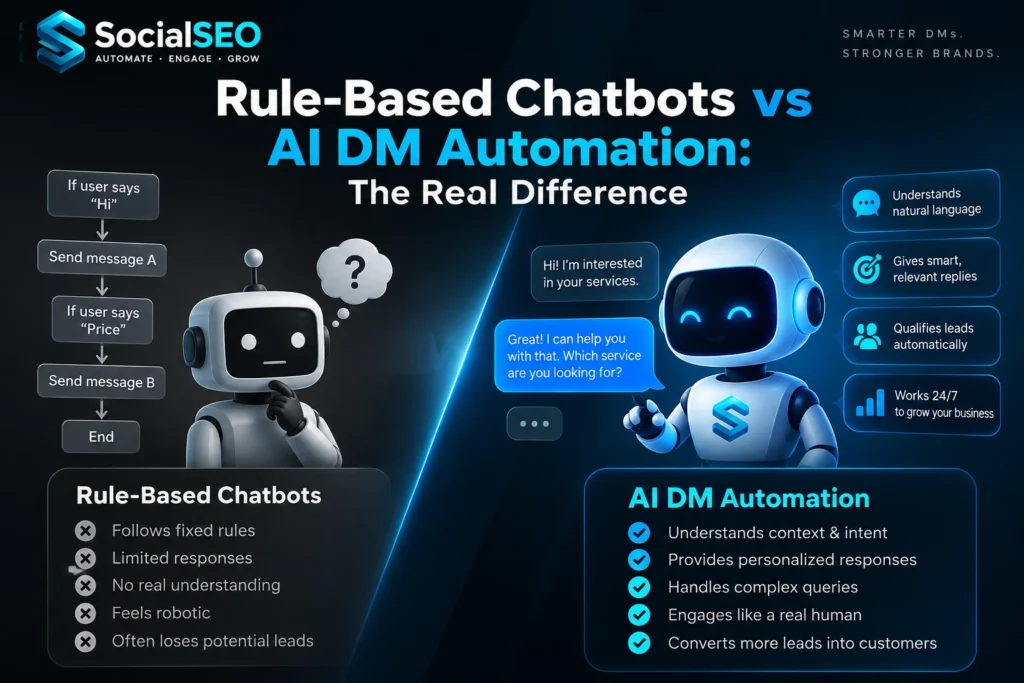
A rule-based chatbot works off a simple idea. If someone says this, reply with that. It follows a fixed script built entirely on exact keywords.
Think of it like a vending machine. You press a specific button, and you get a specific item. Nothing more, nothing less. If you press a button that doesn’t exist, nothing happens.
So if your rule is set up to trigger on the word “price,” and someone comments “how much is this,” the bot has no idea what to do, because “how much” isn’t the exact word it was trained to recognize.
According to IBM’s breakdown of chatbot types, rule-based bots essentially act like an interactive FAQ page, built on predefined question and answer combinations that a conversation designer writes in advance. They work fine for predictable, repetitive tasks, but they fall short the moment a question falls outside what was originally scripted.
What AI DM Automation Actually Is
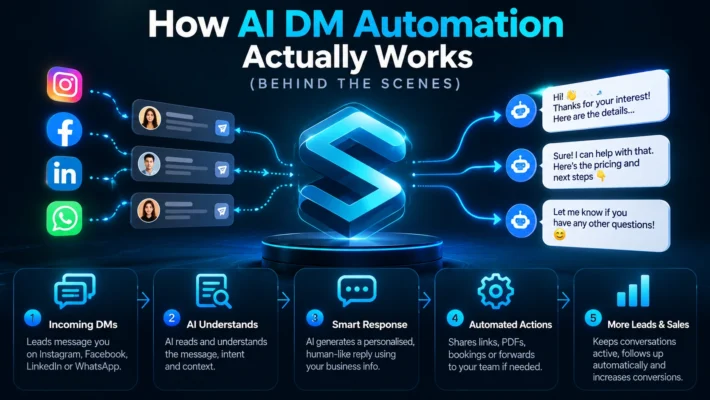
AI DM automation works completely differently. Instead of scanning for exact keywords, it reads the actual meaning behind what someone typed, using natural language processing to understand intent rather than just words.
Natural language processing or NLP is a part of intelligence that helps a system understand human language just like we use it every day. It handles all the mistakes, short forms and odd ways people talk. Of requiring exact words it works with messy real-life speech.
So when someone messages “how much is this,” “what’s the price,” or even “how much does it cost,” an AI system understands all three mean the exact same thing. A rule-based bot would only catch one of them, if you were lucky enough to guess the right keyword in advance.
The Same Message, Tested Two Different Ways
Let’s make this real instead of theoretical.
Someone comments on your Instagram post asking, “do you guys ship to Canada and how long does it usually take?”
Run through a rule-based bot, here is what typically happens. The bot scans for a trigger word like “shipping.” It finds it, and sends a generic pre-written message like “Yes, we ship worldwide. Standard delivery takes 5 to 7 days.” The message never actually answers “Canada” or “how long usually,” it just fires off the closest matching script.
Run through real AI DM automation, the system reads the entire question together. It recognizes this is a two part question, shipping location and delivery timeframe, and responds directly to both, something like “Yes, we do ship to Canada. Delivery usually takes about 7 to 10 business days there.” It feels like a real answer, because it actually is one.
That single example is the whole difference in a nutshell. One system matches words. The other understands people.
Why This Difference Actually Matters for Your Business
A confused or generic reply doesn’t just feel awkward. It quietly costs you customers.
When someone gets an answer that doesn’t actually address what they asked, most people don’t bother typing the question again in a different way. They simply leave the conversation and move on, often to a competitor who replied properly the first time.
This becomes an even bigger problem as your business grows. A rule-based bot needs someone to manually predict every possible way a customer might phrase a question, then write scripts for each one. That list grows endlessly and never fully covers real human conversation. AI DM automation doesn’t need that manual guesswork because it understands variation naturally.
Consumer behavior research backs this up at a broader level too. A widely cited Salesforce study found that 69 percent of consumers prefer chatbots for quick communication with brands, which tells you people are already comfortable with automation. The real question is not whether they’ll accept a bot, it’s whether that bot actually understands them once they start typing.
The Middle Ground Almost Nobody Explains, Hybrid Automation
Here’s something most comparisons skip entirely. You don’t always have to choose one or the other.
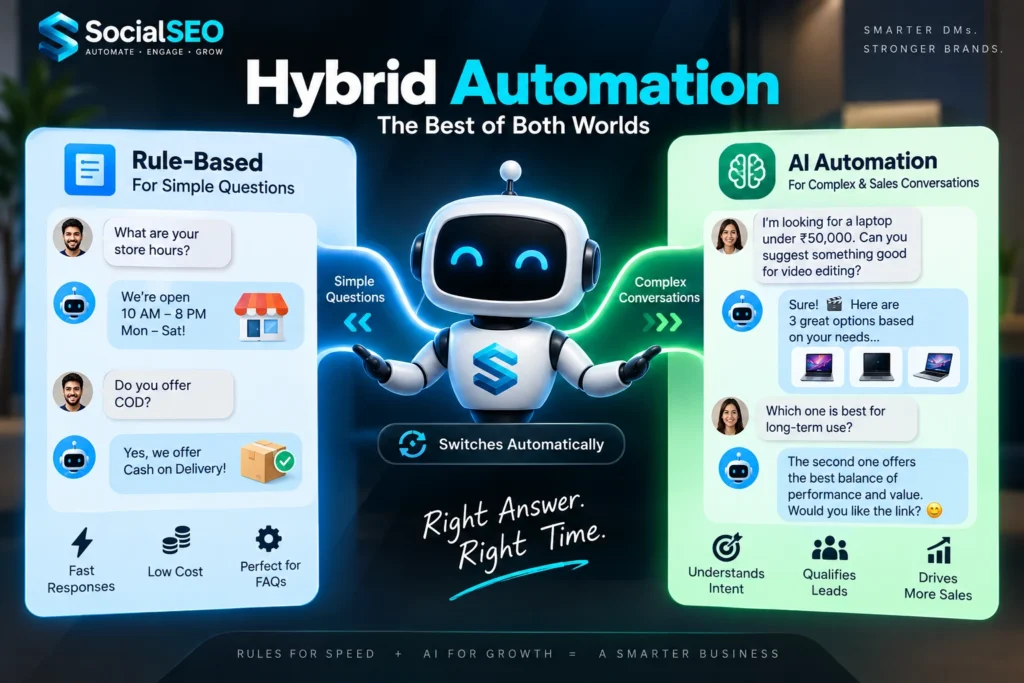
A hybrid system combines both approaches. Simple, predictable questions get handled by fast rule-based logic, since there’s no need for heavy AI just to answer “what are your store hours.” But once a conversation gets more complex, involves multiple questions, or needs real qualification, it switches over to AI to handle the nuance.
This is really the way for many small businesses. You have the speed and low cost of rules, for the things and the smart power of AI exactly where its needed the most during real sales talks and when checking out leads.
What This Actually Costs You in Real Terms
Rule-based bots are cheaper and faster to set up, no argument there. If all you need is an automatic reply for store hours or a simple FAQ, a basic rule-based system does the job fine and won’t cost much.
But if your goal is turning Instagram comments and DMs into actual booked calls or sales, the picture changes. A rule-based system will eventually hit a wall, either through customer frustration or through the constant manual work of writing new rules for every new type of question. AI DM automation costs more upfront, but it removes that ceiling entirely, since it doesn’t need endless manual scripting to keep up with how real people actually talk.
A Founder’s Perspective on Why This Matters More Than It Sounds
“Most business owners think they’re choosing between two software features,” says Suresh Malani, founder of SocialSEO. “What they’re actually choosing is how many potential customers get a real answer versus a generic one. That single difference is often the gap between a comment that turns into a sale and a comment that just disappears.”
This is exactly why the distinction between rule-based and AI DM automation matters more than it first appears. It is not a technical detail buried in a settings page. It directly decides whether the people already engaging with your content actually get converted or quietly walk away.
How to Check Which One You’re Actually Using
If you’re not sure whether your current tool, or one you’re considering, is a real AI system or just a rule-based bot wearing an AI label, here’s a fast way to check.
Message it with a question phrased in an unusual or roundabout way, instead of the obvious keyword version. A rule-based bot will likely miss it entirely or give an unrelated answer. Real AI will understand you anyway.
Ask it two things in one message, the way real customers actually type. A rule-based bot usually answers only one part, or neither. Real AI addresses both.
Send a message with a typo in it. A rule-based bot often fails completely here. AI usually understands you without issue.
The Clear Answer
Rule-based chatbots follow fixed scripts and only respond correctly to exact keywords, making them cheap and fast to set up but limited the moment a conversation gets even slightly unpredictable. AI DM automation uses natural language processing to genuinely understand what someone means, no matter how they phrase it, making it far better suited for real sales conversations and lead qualification. For most growing businesses, the smartest approach is a hybrid setup, simple rules for the easy questions, and real AI handling everything that actually requires understanding a human being.
Frequently Asked Questions
Can a rule-based bot ever understand different phrasing of the same question?
Only if someone manually writes a rule for every possible phrasing in advance, which becomes unrealistic very quickly. This is the core limitation that separates it from AI.
Is hybrid automation better than pure AI?
Not necessarily better, just different. Hybrid setups are often the more practical and cost effective choice for smaller businesses, since they combine low cost speed for simple tasks with real intelligence exactly where it’s needed.
Why does my current DM bot not understand my customers?
It’s likely running on rule-based logic rather than true AI, meaning it can only recognize exact keywords rather than the actual meaning behind a message.
Does AI DM automation completely replace the need for rules?
Not entirely. Even AI powered systems often use some basic rules for very simple, high volume questions, then rely on AI for anything requiring real understanding.
Are these automated systems safe to use on my business account?
Yes, as long as they connect through the platform’s official login process rather than asking for your password directly. Meta publishes its own rate limits for messaging through official channels, which any legitimate automation tool should operate within.
Where to Go From Here
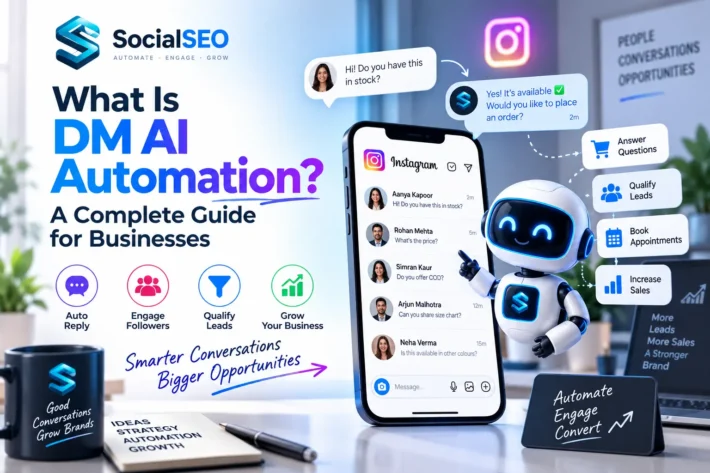
If you want a full breakdown of how to test any tool and spot a fake AI system before you commit to it, our earlier guide on what DM AI automation actually is walks through exactly that. If you’re building out a presence worth automating in the first place, our personal branding and fan page marketing work covers how to get real engagement flowing into your DMs. And if you’re ready to see real AI DM automation in action rather than just reading about it, take a look at Setter, our own AI response agent for Instagram, live at app.socialseo.in.
Written by Suresh Malani
Suresh is the founder of SocialSEO, an AI native content and growth studio based in Noida, India. He works directly with founders and brands on personal branding, fan page marketing, and DM automation systems like Setter, and writes about what actually works based on that hands-on experience.
Connect on LinkedIn: linkedin.com/in/sureshmalani