Why Every Indian Founder Needs a Personal Brand
Summary
Indian founders often avoid personal branding because it feels like self-promotion, but that hesitation is costing them trust, customers, and investors. Founder visibility on LinkedIn has jumped 104% as buyers increasingly verify businesses through trusted people before deciding, not through company pages alone.
A personal brand works differently at each stage: pre-revenue founders should validate ideas publicly, funded founders should build investor credibility, and established founders should aim for category authority.
There are risks with this too. You have to think about what happens if the founder leaves or if people get confused about what the brand’s doing when it changes direction or gets sold. The people in charge can also get really tired because they have to keep coming up with content all the time. That is why it is an idea to think of this as a system and not just something you have to do yourself.
There are examples in India like Nikhil Kamath and Aman Gupta that show how people are more likely to trust a founder and that can make the sales process a lot shorter even before you start talking to them about it. Nikhil Kamath and Aman Gupta are examples of this; they show how having trust in the founder can really help.
Key takeaways
Founder visibility now directly influences buyer trust in India, with most small business marketers confirming that people verify businesses through trusted individuals before making a decision.
Personal branding is not an influencer culture. It’s building trust around expertise, not building an audience around a lifestyle.
The right approach depends on the founder stage. Pre-revenue founders validate publicly, funded founders build investor trust, and established founders aim for category authority.
LinkedIn is the primary platform for Indian founders, though consumer facing founders should treat Instagram as equally important.
Real risks exist, including founder dependency, brand confusion after a pivot or exit, and burnout, so personal branding needs a sustainable system rather than constant personal effort.
Consistency beats intensity. A steady one to two hours a week focused on one clear content pillar outperforms short bursts followed by silence.
Founders who start now, while most of the market still hesitates, get a longer runway to build trust before the space gets crowded.
Introduction
Ask any Indian founder why they haven’t started posting on LinkedIn and you’ll hear the same answer in different words. It feels like bragging. It feels awkward. It feels like something influencers do, not something serious business owners do.
That mindset is quietly costing founders, customers, investors, and talent. In 2026, your name carries more weight than your company’s logo, and the founders who understand this early are the ones pulling ahead.
A recent report on LinkedIn usage among Indian founders found that the number of Indian founders active on the platform has jumped 104% in a short span, as more small business owners recognize that buyers now verify information through trusted people before making a decision, with 82% of India’s small business marketers confirming this pattern and 77% saying networks play a major role in validating a brand. Nearly three out of four Indian SMB professionals also say trusted community input speeds up how fast they make a decision.
Put simply, people are checking you out before they check out your company. If there’s nothing to find, or worse, nothing that feels human, you lose the sale before the conversation even starts.
What personal branding actually means for a founder
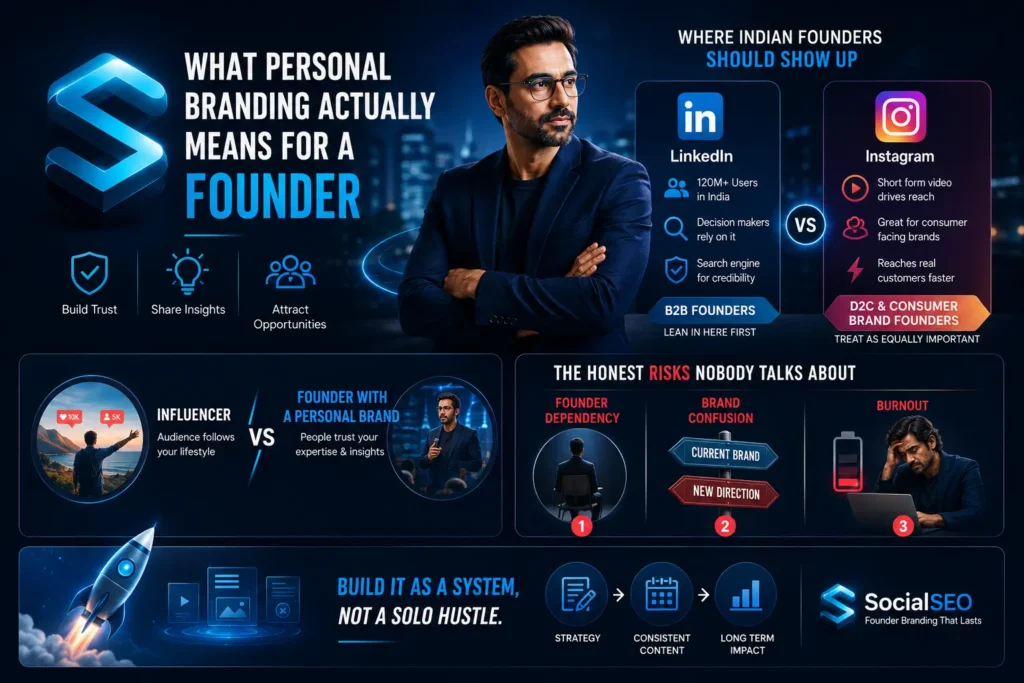
Personal branding gets confused with influencer culture a lot, and that confusion is exactly why so many founders avoid it. Being an influencer means building an audience around your lifestyle. Being a founder with a personal brand means building trust around your expertise.
A company page speaks in a corporate voice. It talks about features, milestones, and offers. A founder speaks as a real person, with opinions, lessons, and a point of view. Buyers, investors, and future employees trust the second one faster, because humans trust humans before they trust logos.
This is not about becoming famous. It’s about becoming known and remembered by the right ten thousand people, not the whole internet. If you want a clearer picture of what that actually looks like in practice, SocialSEO’s founder personal branding service breaks down exactly how a founder’s voice gets turned into a consistent content system.
Why this matters more in India, right now
Indian buyers behave differently from buyers in other markets when it comes to trust. A Forbes piece on founder branding in 2026 points out that a large share of adults don’t trust information posted by companies on social media, yet consumers trust a company far more when its leadership is visibly active, and more than half say visible leadership directly shapes their purchasing decisions. That gap between distrust of company accounts and trust in real leaders is exactly what Indian founders are sitting on top of right now, mostly unused.
Look at how founders like Nikhil Kamath at Zerodha or Aman Gupta at boAt built recognition alongside their companies. Their visibility did something specific. It let potential customers and partners form an opinion about the person leading the business before they ever evaluated the product. That early trust made the actual sales pitch shorter and easier, because half the convincing work was already done.
This is the mechanism most articles on this topic skip. It’s not that founder visibility creates buzz. It’s that founder visibility removes doubt before a buyer even reaches your website.
A personal branding plan based on your stage
Not every founder needs the same approach. What works for a two person startup with no funding will waste time for a Series A company with an investor base to manage. Here’s how to think about it based on where you actually are.
If you’re a pre-revenue solo founder, your job right now is to validate your idea out loud. Share what you’re building, why you’re building it, and what you’re learning as you go. You have zero customers, so your content is your first sales pitch and your first hiring pitch at the same time.
If you are a seed to Series A founder LinkedIn is like your investor relations department. You should share what you know about the market on LinkedIn. Talk about the size of the problem that your company is trying to solve. You should also talk to founders who have gotten funding.
When you talk to someone people think is great and that is good for you too. The LinkedIn platform is a place for the seed to Series A founder to be seen as an expert. The seed, to Series A founder can use LinkedIn to show that they really understand the market and the problem that their company is trying to solve.
If you run an established or enterprise focused business, your content needs to shift toward category authority. B2B buyers like procurement teams or enterprise decision makers care less about your personal story and more about whether you clearly understand their industry better than anyone else talking about it. If your goal at this stage is broader brand reach rather than personal recognition, it’s worth looking at fan page marketing alongside your personal content, since the two work well together instead of competing for attention.
Where Indian founders should actually show up
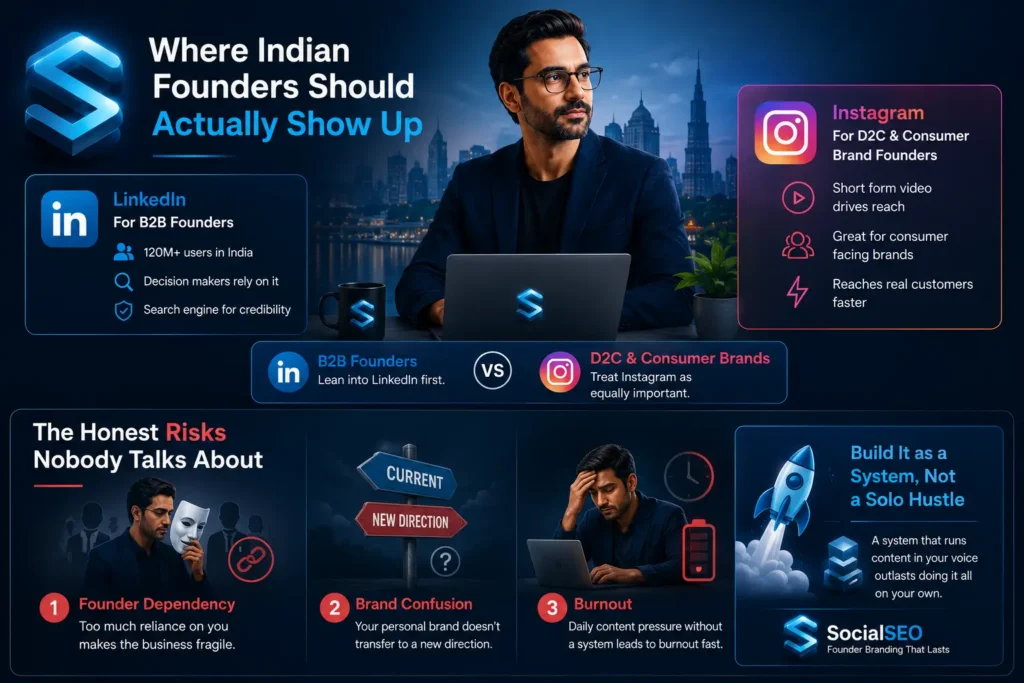
LinkedIn is where most of this trust building needs to happen for Indian founders. With over 120 million users in India and decision makers relying on it for vendor discovery and hiring, it has become far more than a networking platform. It’s closer to a search engine for credibility.
That said, LinkedIn alone isn’t the full answer for every founder. If your business is consumer facing, short form video on Instagram often reaches your actual customers faster than a LinkedIn post ever will. B2B founders should lean into LinkedIn first, while D2C and consumer brand founders should treat Instagram as equally important.
The honest risks nobody talks about
Most content on this topic reads like a cheerleading session. It isn’t complete without talking about the real risks, because pretending there are none doesn’t help you make a good decision.
The first risk is founder dependency. If your entire brand trust sits on your face and your voice, the business can struggle the moment you step back, whether that’s for personal reasons or simply to focus on other priorities.
The second risk is brand confusion. If you ever pivot your business or plan to exit it one day, an audience built entirely around your personal identity doesn’t transfer cleanly to a new owner or a new direction.
The third risk is burnout. Founders already run lean teams and long hours. Adding daily content pressure on top of that without a system in place is one of the fastest ways founders quit personal branding within a month of starting. This is exactly why a system that runs content in your voice without needing you on camera every day, like the model used in SocialSEO’s founder branding service, tends to outlast a founder trying to do everything solo.
None of these risks mean you should skip personal branding. They mean you should build it as a system, not as a personal obligation you carry alone.
Common mistakes Indian founders make
The biggest mistake is posting vague opinions with no clear answer attached. A post that says an industry is broken without explaining exactly why and exactly what fixes it gets likes but builds no real trust. Founders who post specific, opinionated, and useful answers are the ones who actually get remembered and reached out to.
The second common mistake is treating the LinkedIn About section like a resume. Listing your college, your previous jobs, and your current title tells a visitor nothing about why they should trust you today. That space should read like a pitch, not a biography.
The third mistake is starting strong and disappearing after three weeks. A short burst of content followed by silence does more damage to your credibility than never starting at all, because it signals inconsistency to anyone watching.
A real first 30 days plan
Most advice here stops at “be consistent,” which isn’t actionable. Here’s a plan you can actually follow.
In week one, clean up your profile and decide your one line positioning, the sentence that tells people exactly what you’re known for.
In week two, pick one content pillar, one topic area you’ll be known for, instead of trying to cover everything you know.
In week three, start engaging directly with other founders and relevant people in your industry, not just posting and waiting.
In week four, track your first real proof point, whether that’s a message from someone interested in your business, an investor reply, or a genuine customer conversation that started because of something you posted.
If building and sticking to this plan on your own feels unrealistic given everything else on your plate, that’s a completely normal place to land, and it’s worth booking a free strategy call to see what a done for you version of this looks like.
Case study block 1 (place this inside the “stage based framework” section, right after the seed to Series A point)
Take the example of a SaaS founder running an AI tools startup called GrowthOS. He knew his personal brand was sitting there as an untapped asset, but running the company left zero time to build it. Working with SocialSEO, his voice was turned into a full content system that published in his tone within two weeks of onboarding.
By day sixty he had gotten six thousand followers with people talking to him not just a lot of views that do not mean anything and he had ten thousand followers before ninety days were over. The thing we learn from this is not about how followers he had. It is that the biggest problem, for founders is not what to talk about it is finding the time to talk about the founders ideas all the time.
Case study block 2 (place this inside the “honest risks” section, right after the burnout point, since it directly answers the AI authenticity worry)
A wellness and coaching founder running MindfulScale was skeptical going in. Her concern was one a lot of founders share, that an AI-driven content system would sound robotic or generic and quietly damage the trust she’d already built.
It didn’t play out that way. Because the system was built around how she actually speaks and thinks, her audience never flagged the content as inauthentic. Six months in, her following had grown and so had her inbound pipeline. This case matters because it directly answers the objection most founders have before they even start, that scaling a personal brand means losing the personal part.
Table for the informational section
You can place this table right after the “personal branding plan based on your stage” section, since it summarizes that entire section visually and gives Google a clean structured element to pull into search results.
| Founder Stage | Primary Focus | Best Platform | What to Post | Success Signal |
| Pre-revenue solo founder | Validating the idea publicly | Build in public updates, honest lessons, early customer conversations | First inbound message from a stranger | |
| Seed to Series A founder | Investor and market credibility | Market insights, problem sizing, engagement with funded founders | Investor or partner reaching out first | |
| Established or enterprise founder | Category authority | LinkedIn, supplemented by Instagram for consumer facing brands | Industry analysis, thought leadership, original opinions | Being tagged or quoted as an industry voice |
Frequently asked questions
Is personal branding only useful for consumer brands, or does it work for B2B founders too?
It works for both, but the content approach is different. B2B founders should focus on industry expertise and category authority, while consumer brand founders benefit more from personal storytelling and behind the scenes content.
How much time should a founder actually spend on this each week?
A consistent one to two hours a week, focused on a clear content pillar, outperforms sporadic bursts of five hours followed by weeks of silence.
Should a founder build their personal brand or their company brand first?
If you have zero customers and haven’t validated your idea yet, focus on customer conversations first. Once you have some traction, building your personal brand alongside your company brand compounds faster than either one alone.
Is it too late to start personal branding in 2026?
No. The founders who are hesitating today are giving the founders who start now a longer runway to build trust before the space gets more crowded. If you want a structured way to start without doing it all yourself, SocialSEO’s founder personal branding services in India are built exactly for this stage of hesitation.
Conclusion
The discomfort around self-promotion is real, and it’s exactly why so few Indian founders have claimed this space yet. The ones who get past that discomfort and build a real system around their voice are the ones showing up in front of investors, customers, and top talent before their competitors even get in the room.
If building this on your own feels like one more full time job you don’t have time for, that’s exactly the gap SocialSEO’s founder personal branding service is built to close, using an AI clone of your voice to keep you visible without needing you on camera every day.
And if your goal is broader brand visibility rather than personal recognition, our fan page marketing network is built for exactly that kind of reach. You can also book a free strategy call to figure out which path fits where your business is right now.
About the Author
This article is brought to you by SocialSEO, a Noida based digital marketing agency founded by Suresh Malani. The team works with founders and businesses across India and Canada, handling everything from SEO and content strategy to founder personal branding and fan page marketing. SocialSEO’s approach focuses on building real, measurable trust and visibility rather than chasing vanity metrics, which is the same thinking behind every strategy shared in this piece. You can learn more about the team on the SocialSEO about page or get in touch directly if you want help building your own founder brand.